How to Improve Listening in Another Language and Understand Real Speech

You can know quite a lot of a language and still struggle to understand someone when they speak to you.
You may recognize the words when you read them. You may understand your teacher. You may even follow videos made especially for language learners.
Then a real person starts talking.
Suddenly, everything seems faster.
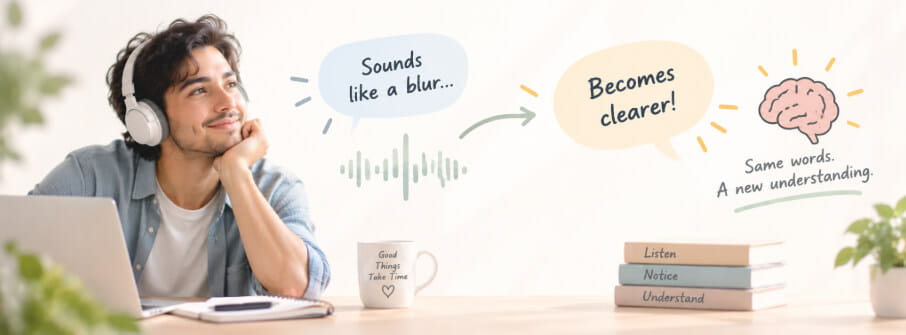
Words seem to run together. A sentence that looks completely familiar on paper becomes difficult to recognize when you hear it. Sometimes you are left thinking:
“I know these words. So why didn’t I understand them?”
This is a very normal part of learning another language.
Listening isn’t simply about knowing more vocabulary. You also have to become familiar with how the language sounds when people actually use it.
Real speech can be fast. Different people have different voices and accents. Words can run together, some sounds can become less clear, and conversations don’t always happen in perfect, quiet rooms.
So if real conversations still feel difficult, it doesn’t necessarily mean you need to go back and memorize hundreds of new words.
Sometimes, you need to train your ears to recognize the language you already know.
Knowing a Word and Recognizing It Are Different Things
Imagine you’ve learned this English question:
What are you going to do this weekend?
When you see it written down, it’s easy enough to understand.
But in everyday speech, you might hear something closer to:
What’re you gonna do this weekend?
English is a useful example because its written and spoken forms can sound quite different in casual conversation.
The problem isn’t necessarily vocabulary.
You may know what, are, you, going, to, do, this, and weekend.
The problem is recognizing those words when they are spoken naturally and quickly.
This happens in different ways across languages.
The language you see in a textbook is usually much easier to separate. Real speech doesn’t always arrive in neat pieces with a pause between every word.
That is why listening practice needs to include more than hearing clearly pronounced individual words.
You need to become familiar with the way the language actually sounds.
Real Speech Doesn’t Wait for You
A language-learning recording is usually designed to help you understand.
Real people aren’t thinking about that.
They might speak quickly because they’re excited. They might change direction halfway through a sentence. They might use an expression you haven’t heard before. Someone might interrupt them. There could be music or other people talking in the background.
And you don’t always know what they’re going to say next.
All of this makes listening different from reading.
The difficulty of listening can depend on things such as the speaker, speed, accent, context, type of speech and what you are trying to understand. The CEFR framework also describes listening ability in terms of different situations and levels of complexity rather than treating listening as simply recognizing individual words.
So don’t be surprised if a language sounds much harder when you first start listening to real people.
Your ears are learning something new.
Choose Listening Material You Can Actually Follow
One mistake is choosing listening material simply because it is difficult.
A two-hour podcast between native speakers may be impressive to have on your playlist, but that doesn’t automatically make it good practice for you.
If you’re a beginner, a short conversation about everyday life may be more useful.
As you improve, you can gradually move toward interviews, podcasts, discussions, TV shows and other natural speech.
The goal isn’t to understand the hardest material you can find.
It’s to find something that is challenging enough to stretch you without becoming completely impossible to follow.
Current British Council listening resources, for example, are organized across different proficiency levels and situations, from simple everyday listening to longer and more complex spoken material.
You can do the same thing yourself.
Start with material that is manageable.
Then make it harder little by little.
You Don’t Need to Understand Every Word
This is one of the most important things to remember when practicing listening.
Suppose someone says:
“We were thinking about going there on Saturday, but the weather doesn’t look very good, so maybe we’ll leave it until next weekend.”
Maybe you miss a few words.
You might still understand the main idea:
They were planning to go somewhere on Saturday, but the weather may change their plans.
That’s comprehension.
You don’t always need to catch every word immediately.
Sometimes you’re listening for the general meaning.
Sometimes you’re looking for one particular detail.
Sometimes you’re trying to understand someone’s opinion.
And sometimes you simply want to know what is happening.
Good listening practice can involve all of these things. Listening activities commonly ask learners to understand the general idea, identify specific information and use context to make sense of what they hear.
So don’t turn every listening exercise into a test of how many individual words you caught.
Understanding the message matters too.
Try Listening to the Same Short Clip Three Times
You don’t always need more and more listening material.
Sometimes, you can learn more by listening carefully to the same short piece of audio.
Find a conversation or video that is perhaps one or two minutes long.
First listen: What is happening?
Just listen.
Don’t pause every few seconds.
Try to understand the situation.
Who is speaking?
What are they talking about?
What seems to be happening?
Don’t worry if you miss things.
Second listen: What did you miss?
Listen again.
This time, notice the parts that were difficult.
Maybe you recognized some words but not others.
Maybe the speaker suddenly became difficult to follow.
Maybe one sentence sounded like a completely different sentence from what you expected.
Third listen: What did they actually say?
Now, if a transcript or subtitles are available, check them.
Look at the parts that confused you.
Then listen to the same section again without looking at the text.
You may be surprised by how much clearer it sounds the second time.
This works because you’re no longer hearing the sentence as something completely unknown. You already know the situation, and now you also know what the speaker actually said.
Subtitles Aren’t the Enemy
There is a common piece of language-learning advice that says you should never use subtitles.
I don’t think it’s that simple.
If you spend the entire video reading the subtitles, you may not pay enough attention to what you’re hearing.
But subtitles can also be very useful when you use them after listening.
Try this:
Listen → check → listen again.
Imagine you hear:
“I dunno if I can make it.”
You may not immediately recognize what was said.
Then you check the subtitles and see:
“I don’t know if I can make it.”
Now listen again.
The sentence may suddenly sound much more familiar.
That’s because you’ve connected the written form with the sound you were hearing.
The aim isn’t to avoid subtitles forever.
The aim is to gradually become less dependent on them.
Transcripts and subtitles can be useful parts of listening practice when they help you connect what you see with what you hear.
Pay Attention to What Your Ears Keep Missing
Instead of simply saying:
“My listening is bad.”
try asking:
“What exactly am I having trouble hearing?”
That’s a much more useful question.
Maybe the problem is speed.
People speak too quickly for you to separate the words.
Maybe it’s connected speech.
You know the words individually, but they sound different when spoken together.
Maybe it’s an accent.
You’re comfortable with one speaker but struggle with another.
Maybe it’s vocabulary.
You simply don’t know enough of the words being used.
Or perhaps you understand individual sentences but lose the main idea when the recording becomes longer.
These are different problems.
And they don’t all need the same solution.
If speed is the problem, work with shorter recordings and replay difficult sections.
If connected speech is the problem, compare the written sentence with how it actually sounds.
If accents are difficult, gradually expose yourself to different speakers.
If vocabulary is the problem, note the words that repeatedly appear in the material you’re listening to.
If you lose the main idea, practice listening for meaning instead of trying to catch every word.
The more specific you can be about the problem, the easier it becomes to work on it.
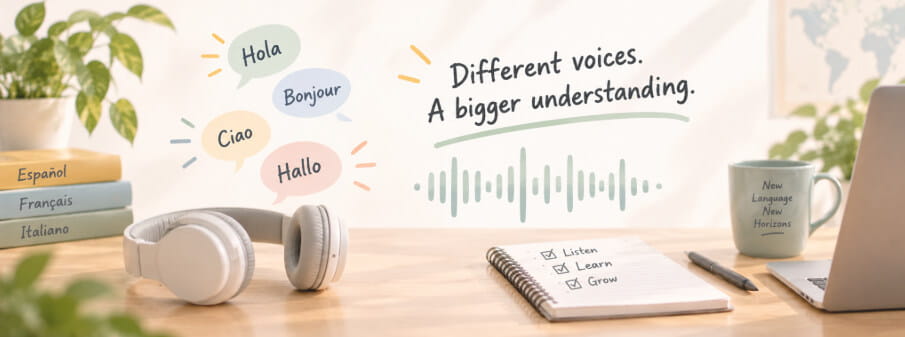
Listen to Different People
You might eventually find one speaker you understand very easily.
That’s great.
But real life doesn’t come with one voice.
People have different accents, voices, speaking habits and rhythms. Even people speaking the same language can sound quite different from one another.
You don’t have to understand every accent straight away.
But listening to different speakers can gradually make unfamiliar voices feel less surprising.
You can start with one familiar speaker and then slowly add others.
A podcast with several guests.
An interview.
A conversation between friends.
A video from another region.
A discussion where people don’t all speak in exactly the same way.
The more variety you hear, the less dependent you become on one particular voice.
Don’t Stay With Learner Audio Forever
Listening exercises designed for learners are useful.
They can give you clear pronunciation, manageable vocabulary and a good place to start.
But eventually, you also need to hear people who aren’t speaking specifically for language learners.
That could be:
- a podcast
- an interview
- a YouTube conversation
- a TV show
- a documentary
- a radio programme
- an online discussion
- a real conversation
You don’t need to understand all of it.
In fact, you probably won’t.
That’s okay.
You can take a two-minute section from a longer programme and work with that.
The goal is to slowly reduce the gap between the language you understand in a learning environment and the language you hear in everyday life.
Eventually, Listen to Conversations You Can’t Control
Recorded material gives you one important advantage: you can pause it.
Real conversations are different.
You don’t know exactly what the other person is going to say.
They may suddenly change the subject.
They may answer in a way you didn’t expect.
They may speak faster than you’re used to.
They may use an expression you’ve never heard before.
And you can’t rewind the conversation every time you miss a sentence.
That unpredictability is part of real listening.
You aren’t simply trying to recognize sounds.
You’re trying to understand another person and what they mean.
That is why real conversations can be such useful listening practice once you are ready for them.
They expose you to the kind of listening that can’t be completely recreated by a carefully prepared language exercise.
Build Up Gradually
You don’t need to jump from beginner recordings straight into fast native-level podcasts.
You can build a simple progression:
Short, clear conversations
→ Short everyday videos
→ Different speakers
→ Longer natural conversations
→ Podcasts, interviews and other unscripted speech
→ Real conversations
And you can move backwards whenever something feels too difficult.
There is nothing wrong with returning to easier material.
In fact, understanding something well can sometimes teach you more than repeatedly listening to something that is far beyond your current level.
Your listening ability develops gradually, just like other parts of language learning.
A 20-Minute Listening Session Can Be Enough
You don’t need to spend an hour listening every time.
Try taking one short piece of audio and giving it your full attention.
For example:
5 minutes: Listen normally.
5 minutes: Listen again and notice what you missed.
5 minutes: Check subtitles or a transcript.
5 minutes: Listen again without looking at the text.
That’s it.
You can do this with a short conversation, part of a podcast or a few minutes from a video.
The important part isn’t making your routine complicated.
It’s making some of your listening active rather than passive.
Having a language playing in the background can be useful for exposure, but focused listening gives you a chance to notice what your ears are actually doing.
Your Goal Isn’t Perfect Listening
There will probably always be situations where you don’t understand everything.
That’s true even in your first language.
People mumble.
They speak too quickly.
There is background noise.
Someone uses an unfamiliar expression.
You lose concentration.
You miss part of a sentence.
None of this means you have failed.
A more useful goal is to become better at making sense of what you hear, even when the language isn’t perfectly clear.
Maybe you miss one sentence but understand the next one.
Maybe you don’t catch every word but understand the speaker’s point.
Maybe you understand the conversation because you recognize the topic and use the surrounding information to fill in the gap.
That is listening too.
Listening Is Also a Conversation Skill
Listening in another language isn’t only about recognizing words. It is also about paying attention to another person and trying to understand what they mean.
This short talk by Prof. Jordan Peterson explores the broader idea of becoming a better listener.
When Real Speech Starts to Sound Familiar
There may eventually be a moment when you hear a sentence that would have sounded like one long stream of noise a few months earlier.
This time, you can hear the pieces.
Not because the person necessarily slowed down.
Not because they suddenly started speaking like a language-learning recording.
Your ears have simply become more familiar with the language.
That is one of the satisfying parts of improving your listening.
You start recognizing more than individual words.
You begin to recognize the rhythm, sounds and patterns of the language itself.
And slowly, real speech becomes less unfamiliar.
So the next time someone speaks to you and you don’t understand everything, don’t immediately assume that you need to memorize hundreds of new words.
Ask yourself:
“What did my ears have trouble recognizing?”
Maybe it was the speed.
Maybe it was the accent.
Maybe several words ran together.
Maybe you understood the words but lost the meaning.
Maybe you simply need more exposure to this kind of speech.
Once you know what the problem is, you can choose better listening practice.
Because improving listening in another language isn’t simply about hearing more.
It’s about becoming better at making sense of what you hear.
And eventually, the language starts to sound less like something you’re studying and more like something you can actually understand.
That is when listening begins to feel less like a language exercise — and more like understanding another person.