
French Pronunciation Practice: Sounds & Rhythm

Have you ever read a French sentence and understood every word, but then struggled to say it out loud? Or listened to a French speaker and wondered how they could speak so smoothly when the written words looked quite different?
You are not alone. French pronunciation can be challenging at first. Some vowel sounds do not exist in English, many final letters are silent, and words often connect when people speak naturally.
The good news is that you do not need to master every pronunciation rule before you can speak French more clearly. You can make progress by focusing on a few important sounds, listening carefully to real examples, and practicing short phrases.
In this guide, we will look at some common French pronunciation challenges, learn how liaison works, explore French rhythm, and try practical exercises you can use in your own French practice.
Why Is French Pronunciation Difficult?
One reason French pronunciation can feel confusing is that the spelling does not always tell you exactly how a word sounds.
For example, the final consonant in petit is normally silent when the word is spoken on its own. In other words, you do not pronounce the final t as you might expect from the spelling.
French also has vowel sounds that many English speakers find unfamiliar. The difference between tu and tout is a good example. Both words contain a similar-looking vowel spelling, but they sound different and have different meanings.
Another challenge is the way French words connect in speech. In a phrase such as vous avez, the normally silent final s in vous is pronounced like a /z/ sound before avez.
And then there is rhythm. French often sounds more connected than English because speakers tend to organize words into meaningful groups rather than giving strong emphasis to every important word.
These differences become easier to understand when you practice them individually and then use them in complete sentences.

French Vowels and Consonants
You do not need to learn the entire French sound system in one sitting. Start with a few common sounds that make a noticeable difference to how clearly you speak.
1. The French U and OU Sounds
The French letters u and ou represent different vowel sounds. Learning to hear and produce this difference is especially useful because changing the vowel can change the meaning of a word.
Compare these examples:
- Tu — you (informal)
- Tout — everything
- Dessus — on top
- Dessous — underneath
The French ou in tout is similar to the vowel sound in the English word “food.” The French u in tu is different. It has no exact equivalent in standard English.
Here is a simple way to practice the French u sound:
- Say “ee” and notice the position of your tongue.
- Keep your tongue in roughly the same position.
- Round your lips as if you were going to say “oo.”
- Try saying tu while keeping your tongue forward.
Now alternate between tu and tout. Listen carefully to the vowel rather than worrying about how quickly you can say the words.
Next, practice dessus and dessous. Try to hear the difference before you repeat each word.
If the two sounds still seem similar, that is fine. Listen to a clear audio example and return to the exercise later. It is easier to improve when you know exactly which difference you are trying to hear.
2. Understanding French Nasal Vowels
French has nasal vowels, which are produced with airflow through the nose as well as the mouth. They are an important part of French pronunciation and can take some time to get used to.
Here are three common examples:
- Sans — without
- Bon — good
- Pain — bread
The vowel sounds in these words are nasal, but they are not all pronounced in the same way.
Compare beau and bon. The word beau contains an oral vowel, while bon contains a nasal vowel. The contrast helps you notice the difference between a vowel produced without nasal airflow and one produced with it.
One common mistake is to pronounce a nasal vowel as an ordinary vowel followed by a clearly pronounced n. In many French words, the written n or m helps indicate a nasal vowel rather than a separate consonant.
However, the spelling alone does not tell the whole story. Whether a vowel is nasal depends on the surrounding letters and the word’s pronunciation.
Try this short exercise:
- Listen to a native French speaker saying sans.
- Repeat the word slowly.
- Listen to bon and repeat it.
- Compare the vowel sounds in beau and bon.
- Repeat the words again, paying attention to the vowel rather than adding an extra consonant at the end.
Do not worry about getting every nasal vowel right immediately. Start by recognizing the difference, then practice producing it.
3. The French R Sound
The French r is another sound that can feel unfamiliar to English speakers.
In much of standard French, the sound is produced towards the back of the mouth, using the uvular area near the back of the tongue. It is different from the English r, which is usually formed further forward.
You can hear this sound in words such as:
- Paris — Paris
- Rouge — red
- Merci — thank you
- Restaurant — restaurant
You do not need to force a strong gargling sound to pronounce the French r. Trying too hard can create unnecessary tension.
Instead, listen to a native speaker and notice where the sound seems to come from. Practice a word such as merci slowly, then say it in a short phrase like Merci beaucoup.
The French r can vary between speakers and regions, so there is no need to copy one person’s accent perfectly. Aim for a clear, comfortable pronunciation.
4. Silent Final Letters in French
Many French words have final consonants that are not pronounced in ordinary speech.
For example:
- Petit — the final t is normally silent when the word is spoken alone.
- Grand — the final d is normally silent.
- Vous — the final s is normally silent when the word is spoken alone.
However, it is important not to assume that every final consonant is always silent. Some are pronounced in particular words, and others may become audible through liaison.
For example, the final s in vous is normally silent when the word is said alone. In vous avez, however, it is pronounced like /z/ because of liaison.
The best approach is to learn the pronunciation of a word in context. When you learn a new expression, listen to the complete phrase rather than relying only on how the words are written.
Understanding French Liaison
Liaison is one reason French can sound so connected when spoken naturally.
It happens when a normally silent final consonant is pronounced before a following word that begins with a vowel sound or a silent h. The consonant connects the two words.
For example:
- Les amis — the final s in les is pronounced like /z/.
- Vous avez — the final s in vous is pronounced like /z/.
- Un enfant — the final n in un connects to the beginning of enfant.
When spoken naturally, les amis can sound roughly like “lay-zah-mee” to an English-speaking learner. This is only an approximation to help you notice the connection; it is not an exact guide to French pronunciation.
But liaison does not happen between every pair of words. French distinguishes between obligatory, optional and forbidden liaison.
Obligatory liaison
Some common expressions normally require liaison in standard French.
Examples include:
- Les amis
- Vous avez
- Un enfant
Practice these expressions as complete phrases. Listen for the connecting consonant and try to reproduce the phrase without separating the words unnecessarily.
Optional liaison
In some contexts, liaison is possible but not always used. The choice can depend on sentence structure, speaking style and formality.
For example, liaison after a plural noun before an adjective can be optional in certain contexts. Speakers may make different choices depending on the construction and style of speech.
You do not need to memorize every exception at the beginning. Start by learning common obligatory liaisons, then notice how liaison is used when listening to longer French sentences.
Forbidden liaison
Some combinations do not take liaison in standard French.
One useful example is the word et, meaning “and.” There is no liaison after et.
For example:
Un garçon et une fille.
This means “A boy and a girl.”
You should not add a linking /t/ sound after et.
Liaison is also forbidden before certain words beginning with an h aspiré. Although this h is not pronounced, it affects whether liaison can occur. These cases are best learned alongside the relevant vocabulary.
Remember that liaison is a specific pronunciation pattern. Not every connection between French words is liaison; another process, called enchaînement, occurs when a consonant that is already pronounced connects to the following vowel.
For now, focus on recognizing common liaison patterns in expressions you hear regularly.
French Rhythm, Stress and Intonation
French rhythm can sound quite different from English.
English often places strong stress on particular words, such as the words carrying the main information in a sentence. French generally relies less on strong stress contrasts between individual words.
French is sometimes described as more syllable-timed than English. However, this does not mean that every syllable receives exactly the same stress or lasts for the same amount of time.
In French, the final syllable of a rhythmic group often receives the main prominence. Speakers also use pitch, phrasing and intonation to communicate meaning and emotion.
The important thing is to practice how words fit together, rather than trying to emphasize each word separately.
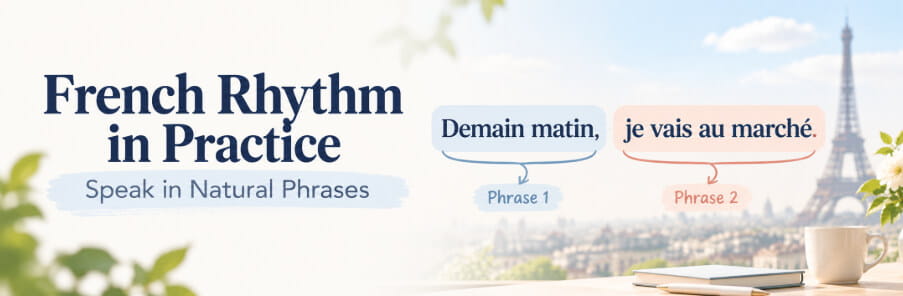
Consider this sentence:
Demain matin, je vais au marché.
It means “Tomorrow morning, I’m going to the market.”
You can practice it in two meaningful groups:
Demain matin / je vais au marché.
The slash is simply a learning aid. It shows one possible way to group the sentence, not a rule that you must pause at that exact point.
First, say each group slowly. Then connect the groups and say the complete sentence at a comfortable pace.
Try another example:
Après le travail, je rentre à la maison.
It means “After work, I go home.”
Notice how the words form a meaningful phrase. Instead of giving every word a strong, separate emphasis, practice letting the sentence flow.
Intonation matters, too. Your voice may rise or fall depending on whether you are asking a question, making a statement or expressing surprise.
For example, a question such as Tu viens ? (“Are you coming?”) can have a different intonation from a statement. The exact pattern depends on the sentence and how the speaker uses their voice.
Listening to complete sentences will help you notice these patterns more easily than studying isolated words alone.
Three Exercises to Practice French Pronunciation
Understanding pronunciation rules is useful, but you also need to practice hearing and producing the sounds. These three exercises give you a simple way to do that.
Exercise 1: Practice Difficult Sounds
Choose one sound contrast at a time. Start with tu and tout.
- Listen to a clear audio example of tu.
- Repeat it slowly two or three times.
- Listen to tout and repeat it.
- Alternate between the two words.
- Say a short phrase containing each word, if you know one.
Next, practice dessus and dessous.
When you are comfortable with these words, move on to beau and bon. Listen for the difference between the oral and nasal vowels.
Try not to rush. Your first goal is to hear the difference clearly. Once you can recognize it, work on producing it yourself.
You can also practice the French r with rouge and merci. Listen to a native speaker and pay attention to how the sound is formed without forcing your throat or tongue.
Check your progress:
- Can you hear the difference between the two target sounds?
- Can you pronounce the words without making them sound identical?
- Can you use the words in a short phrase?
If you find one contrast difficult, keep practicing that pair instead of adding several new sounds at once.
Exercise 2: Group Words Into Natural Phrases
Choose a short French sentence and divide it into meaningful groups.
For example:
Ce soir, nous allons regarder un film.
It means “Tonight, we are going to watch a film.”
You could practice it like this:
Ce soir / nous allons regarder un film.
Follow these steps:
- Listen to the complete sentence.
- Repeat the first group slowly.
- Practice the second group, paying attention to how the words connect.
- Say the complete sentence without adding unnecessary pauses.
- Listen again and compare your rhythm with the original.
Now try:
Après le travail, je rentre à la maison.
You can use the same method with sentences from your French lessons, podcasts or videos.
Do not worry about copying every detail perfectly. Focus on one thing at a time: connecting words, avoiding unnecessary emphasis, or following the natural flow of the phrase.
As your listening improves, you will begin to notice more of the rhythm and intonation that make spoken French sound natural.
Exercise 3: Listen, Repeat and Compare
This exercise helps you notice the difference between what you hear and what you produce.
Choose a short recording from a reliable French-learning resource or a clear native-speaker example. Pick a sentence that you understand and that is only a few seconds long.
Then:
- Listen to the sentence without speaking.
- Listen again and identify one sound or word connection you want to practice.
- Repeat the sentence, copying the speaker’s pronunciation and rhythm as closely as you can.
- Record yourself saying the same sentence.
- Compare your recording with the original.
- Repeat the sentence, focusing on one thing you want to improve.
For example, you might notice that your French u sounds too much like ou. Or perhaps you pronounce words separately when the original speaker connects them naturally.
Choose one issue for your next attempt. Trying to correct every sound and every part of the rhythm at once can make the exercise frustrating.
Use this short checklist when you compare your recording:
- Did I pronounce the target sound clearly?
- Did I connect the words where the speaker did?
- Did I follow the general rhythm of the phrase?
- Can another person understand what I said?
You do not need to sound exactly like the original speaker. The aim is to recognize differences, make adjustments and become easier to understand.
You can repeat the same sentence a few times, then move on to a new one. Over time, these small exercises can help you become more familiar with French pronunciation.
French Pronunciation Videos and Audio Resources
Pronunciation is easier to understand when you can hear the sounds, not just read explanations about them.
When choosing a video or audio lesson, look for resources that demonstrate individual sounds and complete phrases. A useful resource should give you examples to listen to and repeat, rather than only explaining rules.
The videos included with this article can help you explore French phonetics, liaison and the pronunciation of e muet. Before practicing, check that each video is still available and that it teaches the specific topic you want to work on.
A French dictionary with audio pronunciation is also useful when you want to check an individual word. For longer phrases, choose listening material that includes a transcript so you can follow the words while hearing how they connect.
You can make your practice more effective by using a simple sequence:
Listen → Notice → Repeat → Compare
First, listen to the example. Next, notice one sound or pattern. Repeat it yourself, then compare your version with the original.
This approach works well for individual words, short expressions and complete sentences.
If you are comparing French accents, remember that pronunciation can vary across French-speaking regions. You may hear differences in vowels, rhythm and the pronunciation of certain sounds. These differences do not automatically make one speaker more correct than another.
If you want to explore those differences further, read our guide to Parisian and Canadian French.
Make French Pronunciation Part of Your Practice
You do not need a complicated routine to work on French pronunciation. Choose one sound or one short phrase and give it your attention.
For example, you could practice tu and tout, listen to a sentence containing liaison, and finish by repeating a short phrase from a recording.
Keep returning to the same examples until you can hear the differences more easily. Then move on to another sound or phrase.
If you enjoy reading French aloud, you can also try our guide to boosting pronunciation and fluency by reading out loud. It explores reading aloud as a separate way to practice spoken language.
Most importantly, remember that clear pronunciation is not the same as having a perfect French accent. You can speak with a regional or personal accent and still communicate clearly.
The goal is to pronounce words clearly, connect them naturally where appropriate, and make yourself easier to understand.
With regular, focused practice, French sounds and rhythm can become more familiar. Start with one small exercise, listen carefully, and build from there.


