Icebreaker Activities for Language Classes and Conversation Groups

The first few minutes of a language class or conversation group can be a little awkward.
People may not know each other yet. Some learners may be nervous about speaking. Others may understand quite a lot but still be unsure about what to say when they meet someone new.
A good icebreaker gives everyone a simple reason to start talking.
For a language group, though, an icebreaker should do more than fill the first ten minutes. It should give people a chance to use the language with another person.
The best activities are usually simple. They don’t need complicated rules or lots of preparation. What matters is that participants have something specific to ask, share, compare, or discover.
Here are practical icebreaker and mingling activities that can work well in language classes, conversation groups, language exchanges, and online language events.
Why Use Icebreakers in a Language Group?
An icebreaker gives people a starting point.
Instead of telling participants, “Talk to someone,” you give them a small task.
For example:
- Find someone who has visited another country.
- Ask three people about their favorite food.
- Find someone who speaks another language.
- Ask your partner about their weekend.
- Choose between two options and explain your choice.
This makes the first interaction easier because people don’t have to think of a topic from nothing.
For language learners, it also creates a manageable speaking task. A short question-and-answer activity can feel much easier than being asked to have a completely open conversation with someone they have just met.
An icebreaker can also help participants speak with people they might not normally choose as conversation partners.
That becomes especially useful in larger classes, language exchanges, and community events.

How to Choose the Right Language Icebreaker
There isn’t one activity that works for every group.
Before choosing one, think about a few basic things.
Language level
Beginners usually need activities involving:
- names
- hobbies
- likes and dislikes
- simple personal information
- short questions and answers
Intermediate learners can handle:
- opinions
- past experiences
- preferences
- explanations
- descriptions
Advanced learners can usually work with:
- stories
- hypothetical situations
- cultural comparisons
- light debates
- problem-solving
The same activity can often work at several levels. You simply change the questions or how much detail participants are expected to give.
Group size
An activity that works well with six people may become difficult with thirty.
For larger groups, activities that involve changing partners or speaking with several people can work particularly well.
Time
If you have only five or ten minutes, choose something with simple instructions.
If you have more time, you can add another round or change partners.
Online or in person
Some activities are naturally suited to a classroom, while others work well in breakout rooms or one-to-one online conversations.
Preparation
Keep the preparation proportional to the activity.
A useful icebreaker might need nothing more than a few questions written on a board or shared on screen.
Icebreakers for Beginner Language Learners
1. Find Someone Who…
Give participants a list of things to find.
For example:
- Find someone who has a pet.
- Find someone who likes coffee.
- Find someone who has visited another country.
- Find someone who speaks two languages.
- Find someone who likes cooking.
Participants move around the room and ask each other questions.
For a beginner group, the questions can be very simple:
“Do you have a pet?”
“Do you like coffee?”
“Have you visited another country?”
Best for: Beginner and mixed-level groups
Group size: 6 or more
Time: 10–15 minutes
Preparation: A short list of questions
Language focus: Asking simple questions, understanding short answers, and speaking with several people
For more advanced learners, make the questions more open-ended.
Instead of:
“Do you like cooking?”
try:
“What’s something you enjoy cooking?”
The basic activity stays the same, but the language becomes more demanding.
2. Two-Minute Introductions
Put participants into pairs.
Give them two or three questions to discuss:
- What’s your name?
- Where are you from?
- What languages do you speak?
- Why are you learning this language?
- What do you like doing in your free time?
After two minutes, change partners.
Participants then introduce themselves again to someone new.
Best for: Beginners to intermediate learners
Group size: Any
Time: 5–15 minutes
Preparation: A few simple questions
Language focus: Introductions, personal information, basic question-and-answer exchanges
Repeating a similar introduction with different people can make the activity easier as participants become more familiar with the questions.
3. Picture Password
Show participants a picture containing several recognizable objects, people, or situations.
Ask them to describe what they can see.
A beginner might say:
“I can see a woman.”
“There is a table.”
“The people are sitting outside.”
An intermediate learner might say:
“I think they are waiting for someone.”
“Maybe they are meeting for the first time.”
Best for: Beginner to intermediate learners
Group size: Small or medium groups
Time: 5–10 minutes
Preparation: One suitable picture
Language focus: Describing people, objects, places, and simple situations
The same image can therefore be used with different groups without creating a completely different activity.
4. This or That?
Give participants two choices.
For example:
- Tea or coffee?
- City or countryside?
- Summer or winter?
- Movies or books?
- Morning or night?
- Cooking at home or eating out?
Participants choose one and explain their choice.
A beginner might say:
“I prefer coffee.”
An intermediate learner could add:
“I prefer coffee because I usually drink it in the morning.”
For a more advanced group, ask participants to explain their choice in greater detail or respond to someone who chose differently.
Best for: All levels
Group size: Any
Time: 5–10 minutes
Preparation: A list of choices
Language focus: Preferences, giving reasons, agreeing and disagreeing
Icebreakers for Intermediate and Advanced Learners
Once participants can handle basic conversation, the questions can become more open-ended.
5. Childhood Storytime
Ask participants to share a short memory from childhood.
You could give them prompts such as:
- a favorite game
- a favorite meal
- a school memory
- a family tradition
- a place they often visited
Keep the story short.
Intermediate learners might share two or three sentences. Advanced learners can tell a longer story and answer questions from their partner.
Best for: Intermediate and advanced learners
Group size: Pairs or small groups
Time: 10–15 minutes
Preparation: Optional prompts
Language focus: Describing past experiences, sequencing events, and telling short stories
If the group is unfamiliar with storytelling activities, start with one simple prompt rather than several.
6. Top Five
Ask participants to make a list of five things.
For example:
My five favorite foods
Five places I want to visit
Five movies I recommend
Five things I enjoy doing on weekends
Then have them compare their lists with another person.
The list is only the starting point. The conversation comes from the reasons behind the choices.
Someone might say:
“Pizza is number one.”
Their partner could ask:
“Why?”
or:
“What kind of pizza?”
Best for: Beginner to advanced, depending on the topic
Group size: Pairs or small groups
Time: 10–15 minutes
Preparation: A few possible topics
Language focus: Describing preferences, giving reasons, asking additional questions
Choose topics according to the group’s language level.
7. Take a Stand
Give participants a statement and ask whether they agree or disagree.
For example:
“Learning a language is easier when you live in another country.”
Participants choose a side and explain their position.
For intermediate learners, keep the statements straightforward.
For advanced learners, use questions that require more explanation or allow different interpretations.
There doesn’t need to be a correct answer. The point is to give participants something specific to explain, compare, or disagree about.
Best for: Intermediate and advanced learners
Group size: 6 or more
Time: 10–20 minutes
Preparation: A few statements
Language focus: Giving opinions, explaining reasons, agreeing and disagreeing
8. Movie Opinions
Choose a familiar movie, TV show, or type of entertainment and give participants a few questions.
For example:
- What’s your favorite movie?
- What’s the last movie you watched?
- Do you prefer comedy or drama?
- Is there a movie you would never watch again?
- What movie would you recommend to someone learning your language?
Participants compare their answers in pairs or small groups.
You don’t need to choose a movie that everyone has seen. The questions themselves can provide enough material for conversation.
Best for: Beginner to advanced
Group size: Pairs or small groups
Time: 10–15 minutes
Preparation: A few questions
Language focus: Expressing opinions, describing preferences, and making recommendations
Mingling Activities That Get People Speaking
A language icebreaker doesn’t always have to happen around one table.
Mingling activities encourage participants to speak with several different people. This can be especially useful at language exchanges and larger conversation groups.
9. Introduce Your Partner
Put participants into pairs.
Give them a few minutes to learn about each other.
Then each person introduces their partner to the group.
For example:
“This is Maria. She’s from Spain, she works in marketing, and she’s learning English because…”
The activity gives participants a reason to listen carefully to someone else and then explain what they learned.
Best for: Beginner to intermediate learners
Group size: 6 or more
Time: 10–15 minutes
Preparation: A few introductory questions
Language focus: Listening, remembering information, introductions, and speaking about another person
For larger groups, participants can introduce their partner to another pair rather than to the entire room.
10. Culture Swap
Pair participants who have different language or cultural backgrounds.
Give them a simple topic:
- a common breakfast
- a popular celebration
- greetings
- weekend activities
- school traditions
- family meals
Each person explains what the topic is like in their own experience.
Keep the questions personal rather than making assumptions about an entire country.
Instead of asking:
“What do people in your country always eat?”
try:
“What do you usually eat?”
That small change can lead to a more natural conversation.
Best for: Intermediate learners and above
Group size: Pairs or small groups
Time: 10–20 minutes
Preparation: A few discussion topics
Language focus: Describing personal experiences, comparing experiences, and explaining cultural practices
11. Discussion Grid
Participants speak with different people and fill in the grid.
The questions can be very simple for beginners or more open-ended for advanced learners.
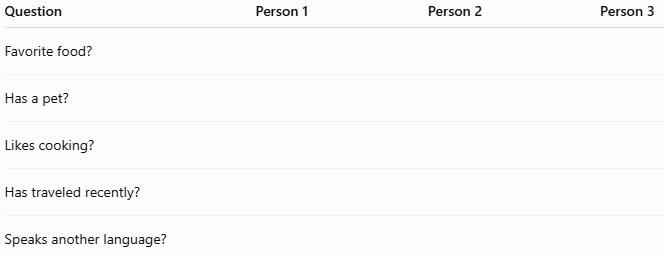
Create a grid with different questions
Best for: Beginner to intermediate learners
Group size: 6 or more
Time: 10–20 minutes
Preparation: A printed or digital grid
Language focus: Asking questions, listening for information, and repeating useful language with different people
Encourage participants to ask one or two extra questions when an answer interests them. This can turn a simple grid into a more natural conversation. You can also learn more about how to ask follow-up questions in another language.
12. Solve a Mystery
Give participants a simple mystery or problem to solve together.
For example:
“Someone left this bag in the classroom. What do you think happened?”
You can provide a few clues and ask the group to discuss what might have happened.
Participants then have to explain their ideas and respond to other possibilities.
Best for: Intermediate and advanced learners
Group size: Small groups
Time: 10–20 minutes
Preparation: A short mystery and a few clues
Language focus: Explaining ideas, making suggestions, giving reasons, and discussing possibilities
This works particularly well when you want an activity that feels more like a conversation than a traditional question-and-answer exercise.

Icebreakers for Online Language Events
Online groups have a different challenge.
People can join a meeting and sit quietly on screen without knowing who they should talk to.
A good online icebreaker makes that first interaction clear.
13. Breakout-Room Introductions
Put participants into pairs or small breakout rooms.
Give them three questions:
- What’s your name?
- Where are you from?
- What are you hoping to practice today?
Give them three or four minutes.
Then bring everyone back and, if appropriate, change the groups.
Best for: Beginner to intermediate learners
Group size: Any
Time: 5–15 minutes
Preparation: Three or four questions and breakout rooms
Language focus: Introductions, simple questions, listening, and short personal answers
For a regular online conversation group, you can change the questions each week.
14. Show Something Nearby
Ask participants to find something within reach and show it to their partner.
It could be:
- a book
- a cup
- a souvenir
- a plant
- something on their desk
Then ask them to explain what it is and why they have it.
A beginner might say:
“This is my coffee cup.”
A more advanced learner could explain where they bought it or why it is important to them.
Best for: Beginner to intermediate learners
Group size: Any
Time: 5–10 minutes
Preparation: None
Language focus: Describing objects, giving simple explanations, and talking about personal experiences
The activity works well online because participants can use something that is already around them.
15. One Question, Three People
Give everyone one question.
For example:
“What’s something you enjoy doing on weekends?”
Participants ask three different people the same question.
Afterwards, ask them to share one interesting answer they heard.
Best for: Beginner to intermediate learners
Group size: 6 or more
Time: 10–15 minutes
Preparation: One question
Language focus: Asking the same question with different people, listening, remembering information, and reporting what someone else said
The activity is particularly useful when participants don’t know each other because nobody has to invent a new topic for every conversation.
How to Make an Icebreaker Useful for Language Practice
A good icebreaker doesn’t need complicated rules.
A few simple choices can make it much more useful for language learning.
Give people a reason to speak
Instead of:
“Talk to your partner.”
try:
“Ask your partner these three questions and find one thing you have in common.”
The second instruction gives the conversation a clear purpose.
Match the activity to the language level
If beginners need ten minutes just to understand the instructions, the activity is probably too complicated.
Keep the instructions simple and demonstrate an example before everyone starts.
Make the first step easy
The first question should give people somewhere comfortable to begin.
For example:
“What’s your name?”
is a much easier starting point for a beginner than:
“Tell your partner about an experience that changed your life.”
The activity can become more challenging once the conversation has started.
Change partners when useful
If everyone stays with the same person for an entire session, participants have fewer opportunities to hear different voices and communication styles.
Changing partners can give people more chances to use the same language in slightly different conversations.
Keep correction appropriate to the activity
If the purpose of the icebreaker is to get people interacting, stopping every sentence to correct a small mistake can interrupt the conversation.
That doesn’t mean mistakes should never be corrected. It simply means the correction should match the purpose of the activity.
Adapt the Same Icebreaker to Different Levels
You don’t always need a completely different activity for each level.
Often, you can keep the activity and change the language required.
Take “Tea or coffee?”
A beginner might say:
“Coffee. I like coffee.”
An intermediate learner might say:
“I prefer coffee because I drink it every morning.”
An advanced learner might discuss how their preferences have changed or compare coffee and tea culture in different places.
The activity is the same.
The language demand changes.
This is useful for mixed-level groups because you don’t necessarily need to divide everyone into completely different activities.
A Simple 10-Minute Language Group Icebreaker
If you’re hosting a language session and want something straightforward, try this:
Minutes 1–2: Quick introductions
Ask everyone to say their name and the language they are practicing.
Minutes 3–5: Pair conversation
Give participants two simple questions.
For example:
- Why are you learning this language?
- What do you enjoy doing in your free time?
Minutes 6–8: Change partners
Ask everyone to speak with someone new.
Give them one different question.
Minutes 9–10: Share
Ask a few participants to share something interesting they learned about another person.
That’s enough to get the session moving.
The icebreaker has given people a chance to speak with someone new, hear another person’s answers, and become a little more comfortable using the language.
Don’t Let the Icebreaker Become the Whole Session
An icebreaker is usually a starting point, not the main activity.
Once people have spoken to a few others and become more comfortable, move naturally into the main part of the session.
That might be:
- a conversation topic
- a language lesson
- a discussion
- a role-play
- a language exchange
- a speaking activity
- an informal conversation
The transition can be very simple:
“Now that you’ve spoken with a few people, let’s stay with your current partner and talk about today’s topic.”
This connects the icebreaker to the rest of the session instead of making it feel like a separate game.
And once people are comfortable, you can use other conversation techniques to keep a conversation going in another language.
The Best Icebreaker Is Often the Simplest One
A useful language icebreaker doesn’t have to be complicated.
Give people a clear task. Match the activity to their level. Make sure they have something specific to talk about, and give them a reason to interact with someone else.
That’s often enough to change the first few minutes of a language class or conversation group.
Once the activity has done its job, the real value comes from what happens next: people start talking, listening, asking questions, comparing experiences, and using the language with another person.
And that’s where an icebreaker becomes more than just an activity at the beginning of a class.
It becomes the first step toward a real conversation.