11 TED Talks That Can Help You Learn a Language

Learning a new language involves more than memorizing vocabulary and studying grammar. You also need to understand how people communicate, find ways to remember what you learn, and become comfortable using the language in real situations.
TED and TEDx talks can introduce you to different approaches to language learning. Some explore how languages shape our thinking, while others share ideas about speaking confidence, memory, pronunciation and having better conversations.
I’ve selected 11 talks that offer different perspectives on language learning and communication. You don’t need to watch all of them at once. Choose one that matches your current goal, take a few notes, and try applying an idea to your own language practice.

1. How Language Shapes the Way We Think — Lera Boroditsky
Best for: Understanding the relationship between language, culture and thought.
Cognitive scientist Lera Boroditsky explores how languages can influence the way people think about time, space and other aspects of the world. She shares examples of differences between languages, including how some communities describe directions and how languages categorize colors.
The talk is a reminder that learning another language can introduce you to ways of describing and understanding the world that may be different from your own.
What you can take away:
- Languages don’t all describe the world in the same way.
- Learning vocabulary also means learning how words are used within a particular language and culture.
- Comparing two languages can help you notice patterns you might otherwise overlook.
Try this: Choose five everyday expressions in your target language that don’t translate neatly into English. Find out when people use them and whether they express an idea differently from the English equivalent.
Watch: How Language Shapes the Way We Think — Lera Boroditsky (TED)
2. 10 Ways to Have a Better Conversation — Celeste Headlee
Best for: Becoming a better listener and conversation partner.
Celeste Headlee is a writer and radio host who shares lessons from her experience interviewing people. Her talk focuses on what makes conversations more meaningful, including listening carefully, staying present and being genuinely interested in the other person.
Although this isn’t specifically a language-learning talk, its ideas are particularly useful when practising a language with other people. A successful conversation isn’t just about finding the right words. It’s also about paying attention, responding to what someone says and giving them space to speak.
What you can take away:
- Listen to understand rather than simply waiting for your turn to speak.
- Stay focused on the conversation instead of planning every sentence in advance.
- Respond to what the other person says rather than repeatedly bringing the discussion back to yourself.
Try this: During your next language exchange, focus on listening carefully. Before introducing a new subject, respond to something your partner has just said or ask a follow-up question about it.
Watch: 10 Ways to Have a Better Conversation — Celeste Headlee (TEDxCreativeCoast)
3. The Secrets of Learning a New Language — Lýdia Machová
Best for: Finding a language-learning approach you can enjoy and maintain.
Lýdia Machová is a language mentor who has learned several languages and studied the approaches used by polyglots. In this talk, she explores how people learn languages independently and presents four principles that help make the process more enjoyable and sustainable.
One of the central ideas is that you don’t need to be born with a special talent for languages. Finding approaches that work for you and continuing to use them can make a real difference to your learning routine.
What you can take away:
- There isn’t one learning method that suits everybody.
- Enjoyment can make it easier to maintain a regular learning habit.
- You can experiment with different resources and activities until you find what works for you.
- Learning a language independently is possible when you have a clear approach and consistent practice.
Try this: Choose one activity you genuinely enjoy, such as watching short videos, reading simple stories or listening to podcasts. Use it in your target language for 15 minutes a day this week. Notice which parts help you learn and which parts need extra support.
Watch: The Secrets of Learning a New Language — Lýdia Machová (TED)
4. Hacking Language Learning — Benny Lewis
Best for: Moving from studying a language to actually using it.
Benny Lewis is known for encouraging learners to use languages actively instead of waiting until they feel completely ready. His approach challenges the idea that you must know a great deal before you can start communicating.
The important point isn’t that preparation or grammar study is useless. It’s that studying can become a comfortable way to avoid the uncertainty of real communication. At some stage, you need to use what you’ve learned.
What you can take away:
- Don’t let the fear of making mistakes prevent you from practicing.
- Look for opportunities to use the language, even when your vocabulary is limited.
- Choose learning materials that interest you so you have a reason to return to them.
- Treat communication as a skill that develops through use.
Try this: Have a two-minute conversation in your target language about something familiar. If you don’t know a word, explain the idea another way. Afterward, note three words or expressions you wanted to use but couldn’t remember.
5. 5 Techniques to Speak Any Language — Sid Efromovich
Best for: Getting more comfortable speaking a language you’re still learning.
Sid Efromovich shares five techniques that helped him approach language learning in a more enjoyable and less stressful way. His talk emphasizes accepting mistakes, experimenting with unfamiliar sounds and structures, and finding opportunities to practice with other people.
This is useful if you understand more than you can comfortably say. You may know plenty of words but still struggle to put them together quickly when somebody asks you a question.
What you can take away:
- Allow yourself to make mistakes instead of expecting every sentence to be correct.
- Practice unfamiliar sounds and structures rather than avoiding them.
- Try speaking aloud to yourself as well as with other people.
- Find a conversation partner who gives you opportunities to use the language.
Try this: Spend two minutes talking aloud in your target language about your day. Don’t stop every time you make a mistake. When you finish, choose one thing you struggled to express and practice saying it in a different way.
6. How to Learn Languages Effectively — Matyáš Pilin
Best for: Thinking about how to organize your language-learning practice.
In this TEDxYouth talk, Matyáš Pilin shares ideas about learning languages effectively and how polyglots find the time and energy to learn multiple languages.
The talk is useful for learners who want to think more deliberately about their routines. Collecting apps, books and videos is easy; deciding how to use them consistently is often harder.
What you can take away:
- Think about how you can make language learning a regular part of your life.
- Explore different ways of engaging with a language and its culture.
- Choose learning activities that suit your interests and circumstances.
- Focus on a manageable routine rather than relying on occasional bursts of motivation.
Try this: Choose a short video or audio clip in your target language. Listen once for the general meaning. Listen again and write down three useful expressions. Then make your own sentence with each expression and say the sentences aloud.
7. Breaking the Language Barrier — Tim Doner
Best for: Exploring how languages connect with culture and personal interests.
Tim Doner became widely known for his interest in learning multiple languages. In this TEDxTeen talk, he discusses his experiences with languages and the ways they can help people explore other cultures.
His story offers a useful reminder that learning a language isn’t simply about memorizing rules or collecting vocabulary. It can also be a way to understand how people express ideas, tell stories and make sense of their experiences.
His personal experience is interesting, but it shouldn’t be treated as a guaranteed method or timeline for everyone.
What you can take away:
- A language can give you access to cultural ideas that are difficult to express through direct translation.
- Personal interests can give you a reason to keep learning.
- Understanding a language involves more than knowing individual words.
- Exploring different languages can make you more curious about how people communicate.
Try this: Choose a short video in your target language about a subject you enjoy. Pick three expressions from it and use each one in a sentence about your own life. If an expression doesn’t translate directly into English, try explaining what it means instead.
8. How to Learn Any Language Easily — Matthew Youlden
Best for: Building a manageable and enjoyable learning routine.
Matthew Youlden is a polyglot who has spoken about his experiences learning languages. In this TEDx talk, he explores approaches to language learning and challenges some common assumptions about what it takes to learn another language.
The title may make the process sound easier than it feels in reality. Learning a language still takes time, and different skills develop at different speeds. The useful idea is to make practice regular and manageable instead of relying on occasional bursts of motivation.
What you can take away:
- Build a routine you can maintain.
- Practice producing the language aloud, not only recognizing words on a page.
- Make room for activities you enjoy, not only exercises that feel like work.
- Pay attention to what helps you remember and use the language.
Try this: Set aside 10–15 minutes a day for one week. Review a few useful expressions, say them aloud and use them in new sentences. At the end of the week, check which expressions you can remember and use without looking at your notes.
9. Why We Struggle Learning Languages — Gabriel Wyner
Best for: Understanding memory and the challenges of learning vocabulary.
Gabriel Wyner, author of Fluent Forever, explores why language learning can feel difficult, particularly when learners compare their progress with that of children. He discusses the role of memory and the importance of understanding how learning takes place.
One useful point is that children often have far more exposure to a language than adult learners realize. Comparing your classroom experience with a child’s everyday exposure can give you an unrealistic picture of how quickly you should progress.
What you can take away:
- Remembering new information is an important part of language learning.
- Repeated exposure and opportunities to retrieve information can help you strengthen memories.
- Difficulty remembering a word doesn’t mean you’re incapable of learning it.
- It’s worth experimenting with how you practice and review new material.
Try this: Choose five useful words or expressions you’ve recently learned. Instead of simply rereading them, cover your notes and try to recall their meanings. Then use each one in a new sentence. Review them again a day or two later.
Watch: Why We Struggle Learning Languages — Gabriel Wyner (TEDxNewBedford)
10. How to Learn Any Language in 6 Months — Chris Lonsdale
Best for: Thinking differently about exposure, understanding and communication.
Chris Lonsdale presents an approach to language learning that focuses on understanding messages, engaging with the language and making communication part of the learning process.
The title is ambitious, but it shouldn’t be taken as a promise that everyone can reach fluency in six months. Results depend on the language, the learner’s starting point, the time available, the type of practice and what they mean by fluency.
The talk is worth watching for its ideas about making language input meaningful and focusing on communication rather than waiting for perfect knowledge.
What you can take away:
- Try to understand the overall message rather than translating every word.
- Use context, gestures and situations to help you understand.
- Make opportunities to engage with the language instead of studying it only in isolation.
- Accept that communication can begin before you know everything.
Try this: Watch a short video in your target language without pausing after every unfamiliar word. First, try to understand the general topic. Watch it again and identify a few useful expressions. Then explain the main idea aloud in your own words.
11. How to Talk Like a Native Speaker — Marc Green
Best for: Noticing pronunciation, rhythm and natural expression.
Marc Green’s TEDx talk explores language proficiency and what it means to speak a language at an advanced level. It raises questions about the difference between communicating successfully and developing a deeper command of pronunciation, expression and cultural nuance.
You don’t need to eliminate your accent to communicate well. The more useful goal is to make yourself understandable, recognize common patterns and become more comfortable expressing yourself.
What you can take away:
- Pay attention to how complete phrases sound, not just how individual words are pronounced.
- Notice rhythm, stress and intonation when listening to fluent speakers.
- Repeat useful expressions aloud to practice producing them.
- Think about your own goals instead of assuming that native-like speech is necessary for success.
Try this: Choose a short sentence spoken by a fluent speaker. Listen to it a few times, then repeat it while paying attention to rhythm and stress. Record yourself and compare the two. Choose one feature to practice rather than trying to change everything at once.
Watch: How to Talk Like a Native Speaker — Marc Green (TEDxHeidelberg)
How to Use TED Talks to Improve Your Language Skills
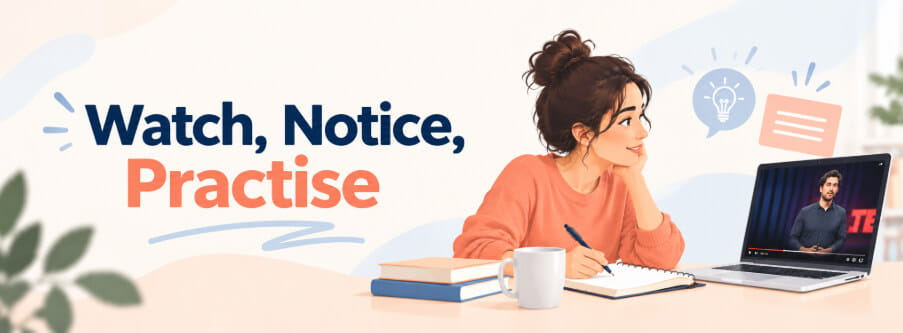
Watching a talk can introduce you to useful ideas, but watching alone doesn’t guarantee that you’ll remember or use them. A little active practice can make the experience more valuable.
1. Choose a talk that matches your current goal
If you want to improve your listening and conversation skills, start with Celeste Headlee. If you’re looking for ways to organize your learning, try Lýdia Machová. If you’re interested in how language and culture connect, watch Lera Boroditsky.
You don’t need to understand every sentence to benefit from a talk. Choose something you can follow reasonably well, and use subtitles when they help.
2. Watch for meaning first
On your first viewing, focus on the speaker’s main idea. Don’t pause every few seconds to look up words. Try to understand the overall message before worrying about details.
On the second viewing, note a few expressions, examples or ideas that interest you.
3. Explain what you learned
After watching, close the video and explain its main point aloud. You can start with simple sentences:
- The speaker talks about…
- One thing I learned is…
- I found it interesting because…
- I agree with this idea because…
If you’re a beginner, a few sentences are enough. If you’re more advanced, try summarizing the talk in your own words without reading your notes.
4. Turn one idea into a real conversation
Share what you learned with a language partner or conversation group. Explain which point you found interesting and ask the other person what they think.
For example, after watching Celeste Headlee’s talk, you could discuss what makes someone a good listener. After watching Lera Boroditsky, you could compare how two languages express time, direction or emotions.
This is where the ideas become useful: you practice listening, retrieving vocabulary, forming opinions and responding to another person.
5. Return to the language you found useful
You don’t need to memories an entire talk. Select a handful of expressions that are useful to you, review them later and try using them in different situations.
The goal isn’t to collect notes about language learning. It’s to use what you learn.
Which TED Talk Should You Watch First?
If you’re not sure where to start, use this quick guide.
- You want to find a learning method that suits you: Start with Lýdia Machová.
- You want to become a better conversation partner: Start with Celeste Headlee.
- You’re interested in language and culture: Start with Lera Boroditsky.
- You hesitate because you’re afraid of making mistakes: Try Sid Efromovich.
- You want to practice listening and summarizing: Choose any talk on a subject you already find interesting.
You can always watch another talk later. One video that you actively use may be more valuable than several that you watch without doing anything afterward.
From Watching to Speaking
TED and TEDx talks can introduce you to new ways of thinking about language learning, communication and the relationship between language and culture. They can also give you ideas to try when your current learning routine feels repetitive.
But you don’t have to follow every technique a speaker recommends. Different learners have different needs, schedules and goals. Take what seems useful, try it for yourself and keep what helps.
Most importantly, don’t let watching videos become a substitute for using the language. Listen, practice, make mistakes, ask questions and talk to people whenever you can.
Learn from the ideas, then put them into practice. That’s how a useful video can become part of your language-learning journey.