
How to Ask Follow-Up Questions in Another Language

You understand what someone just said in the language you’re learning.
You even have something to say about it.
But then comes the difficult part:
What do you ask next?
This is one of those small moments that can make speaking another language feel much harder than it actually is.
The good news is that you usually don’t need a new topic.
The other person has already given you one.
A follow-up question starts with something they just said. Your job is to notice one detail and explore it.
What Is a Follow-Up Question?
A follow-up question is a question that responds to something someone has already said.
Imagine someone tells you:
“I’ve been learning Spanish for two years.”
You could change the subject completely:
“Where do you live?”
Or you could stay with what they just told you:
“What made you start learning Spanish?”
“Do you get many chances to practice?”
“What do you find most difficult?”
The difference is simple.
The second questions come from the conversation itself.
That makes follow-up questions particularly useful when you’re speaking another language. Instead of searching your memory for a prepared question, you can use information the other person has already given you.
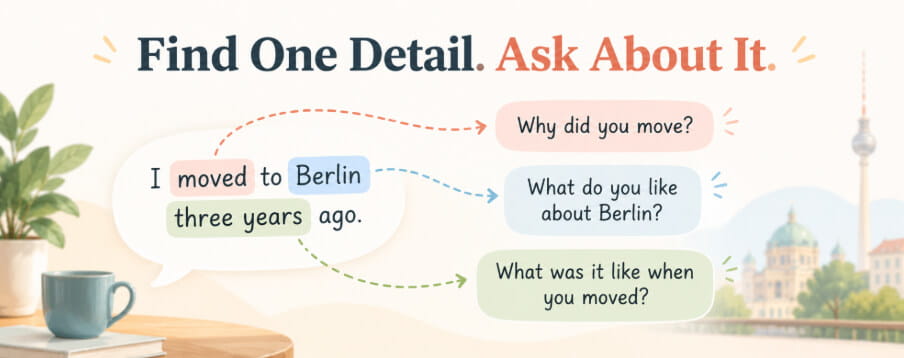
Start by Noticing One Detail
When someone speaks, try not to think about your next sentence too early.
Listen for one detail that stands out.
For example:
“I moved to Berlin three years ago.”
There are several things you could ask about.
The place
“What do you like about Berlin?”
The time
“What was it like when you first moved there?”
The move
“Why did you decide to move?”
You don’t have to use all three.
Choose one.
The useful habit is simple:
Notice something → become curious about it → ask about it.
You aren’t trying to control the whole conversation. You’re responding to what is actually happening.
Use the Other Person’s Words
Creating a completely new sentence in another language can take a lot of mental effort.
Sometimes the easiest way forward is to use language the other person has already given you.
Imagine someone says:
“My brother lives in Canada.”
You could ask:
“How long has your brother lived there?”
Or:
“Does he like living in Canada?”
The conversation has already given you:
- brother
- Canada
- lives
You simply choose one part and build a question around it.
Another person might say:
“I’m thinking about moving to Portugal next year.”
You could ask:
“Why Portugal?”
“Where in Portugal?”
“Have you been there before?”
You’re not starting from zero.
You’re using the conversation as a kind of vocabulary bank.
For language learners, that can make spontaneous speaking much easier.
What Can You Ask About?
There isn’t one correct type of follow-up question.
Once you’ve noticed a detail, you can take the conversation in different directions.
Ask about a detail
“I visited Rome last month.”
“Which part of Rome did you visit?”
Ask about an experience
“I tried Korean food for the first time.”
“How was it?”
Ask about a reason
“I decided to learn French.”
“What made you choose French?”
Ask about a reaction
“I watched that movie yesterday.”
“Did you like it?”
Ask what happened next
“I started a new job last week.”
“How’s it going so far?”
These aren’t five types you need to memorize.
They’re simply different ways of being curious about something the other person has already mentioned.
Don’t Ask the Same Kind of Question Every Time
“Why?” is an easy question to remember, so it’s tempting to use it whenever someone says something interesting.
But if every answer is followed by:
“Why?”
the conversation can start to sound like an interview.
Imagine someone says:
“I moved to London last year.”
You could ask:
“Why?”
But you could also ask:
“How are you finding London?”
“Where were you living before?”
“What was the biggest change for you?”
“Do you think you’ll stay there?”
Each question opens a different part of the story.
The goal isn’t simply to ask more questions.
It’s to notice what part of the person’s experience you genuinely want to explore.
Is Your Question Connected to What They Said?
Here’s a useful test.
Someone says:
“I went hiking with my sister last weekend.”
You ask:
“Where did you go hiking?”
That’s clearly connected.
You could also ask:
“Do you and your sister hike together often?”
Again, the connection is obvious.
But if you suddenly ask:
“What kind of music do you like?”
that’s a perfectly valid conversation question, but it isn’t really a follow-up question.
The distinction matters.
Before asking, try this:
Can I point to the part of their last answer that gave me this question?
If you can, you’re probably following the conversation rather than following a script.
And that’s the real skill we’re trying to develop.
Short Questions Can Be Natural Too
Follow-up questions don’t always have to be long or complicated.
Someone says:
“I finally passed my driving test.”
You might respond:
“Really?”
Or:
“When?”
Or:
“How did it go?”
Or:
“First attempt?”
These examples are from English, and other languages have their own ways of making short questions and reactions sound natural.
The larger point is that real conversation doesn’t require every sentence to be perfectly formed and complete.
Sometimes a short question is enough to show that you’re interested and give the other person somewhere to go next.
Don’t Turn the Conversation Into an Interview
There is another side to follow-up questions.
Once you realize how useful they are, you might start asking too many.
Someone says:
“I went hiking on Sunday.”
You ask:
“Where?”
They answer.
“Who did you go with?”
They answer.
“How long were you there?”
They answer.
“What did you eat?”
At some point, it can stop feeling like a conversation.
A natural conversation has room for questions, reactions, opinions and your own experiences.
For example:
A: I went hiking on Sunday.
B: Oh, nice! Where did you go?
A: Near the lake outside the city.
B: I’ve heard that’s a beautiful area. Did you go with friends?
A: Yeah, a couple of friends.
B: Nice. I haven’t been hiking there yet.
The questions help the conversation develop, but they aren’t the whole conversation.
You Don’t Have to Understand Every Word
You can sometimes ask a useful follow-up question even when you haven’t understood everything.
Imagine someone says:
“…and then I went to Barcelona…”
You may have missed the rest of the sentence, but you heard Barcelona.
You can still ask:
“Barcelona?”
Or:
“You went to Barcelona?”
That may be enough for the person to explain more.
You don’t need complete understanding before participating in a conversation.
If the problem is that you’re stuck because you don’t know a particular word, that’s a different skill. Read – What to Say When You Don’t Know a Word
Here, the point is simply that one understood detail can be enough to continue listening and asking.
Try Turning Statements Into Questions
Here’s a simple way to practice.
Take an ordinary statement and imagine that somebody has just said it to you.
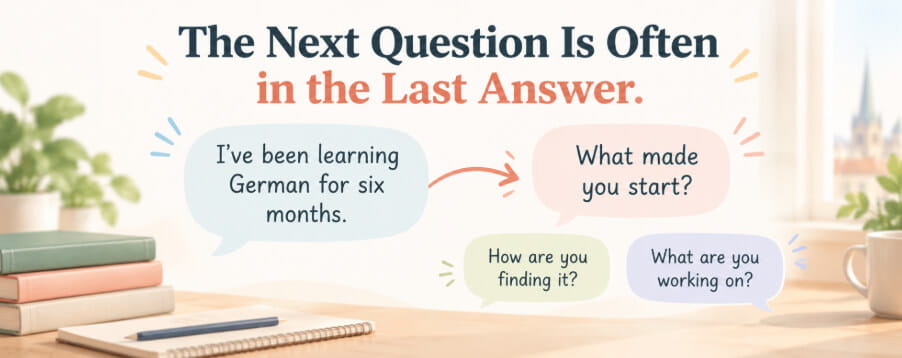
“I’ve been learning German for six months.”
What could you ask?
“Why did you start?”
“How are you finding it?”
“What are you working on at the moment?”
There isn’t one correct answer.
Now try another:
“I watched a Spanish series last night.”
You could ask:
“Which series?”
“Did you like it?”
“Would you recommend it?”
Again, you’re not looking for the perfect question.
You’re training yourself to see several possible questions inside one statement.
You can even practice with something you hear in a podcast, video or conversation. Pause after a sentence and ask yourself:
“What could I ask about that?”
Then continue listening.
The Skill Isn’t Memorizing Questions
There are plenty of lists of conversation questions you can memorize.
They can be useful, especially when you’re just getting started.
But real conversations don’t always follow a predictable script.
Someone might suddenly mention:
- a new job
- their grandmother
- a football match
- a book they’re reading
- a problem they’re having
- a trip they just took
You can’t prepare a question for every possible subject.
What you can practice is the ability to notice:
“There’s something here I could ask about.”
Research on second-language interaction has also highlighted this difference: follow-up questions depend on what another person actually says, so they cannot be completely planned in advance.
That is why learning to create a follow-up question can be more useful than memorizing a long list of them.
The goal isn’t to remember more questions.
It’s to become better at finding your next question inside the conversation you’re already having.
Follow-Up Questions Start With Listening
Although this article is about asking questions, the skill actually begins with listening.
If you’re already planning your next sentence while someone is talking, you may miss the small detail that would have given you the most natural response.
Instead, stay with what they’re saying.
Maybe you hear:
“I went to Japan with my parents.”
You notice:
Japan.
Or:
parents.
Or:
the trip itself.
Any of those can give you somewhere to go.
You don’t have to catch everything.
You just need to catch something.
The Next Time You’re Stuck, Look Back at the Conversation
The next time you don’t know what to ask in another language, don’t immediately search for a completely new topic.
Look at the sentence the other person just gave you.
Find one detail.
Ask about it.
Then listen to the answer.
You don’t need an endless supply of conversation questions. You need to become better at noticing the possibilities already inside the conversation.
And once you start doing that, a conversation can feel very different.
You’re no longer trying to remember what you’re supposed to say next.
You’re listening to a person, noticing what they give you, and responding to it.
Sometimes the next question is already hiding in the last answer.