
How to Keep a Conversation Going in Another Language

You say hello.
You ask where someone is from.
They answer.
You ask one more question.
They answer again.
And then suddenly, you have no idea what to say next.
Sound familiar?
Keeping a conversation going in another language can sometimes feel harder than starting one. You may know plenty of words and understand what the other person is saying, but when it is your turn to respond, your mind starts searching for the right thing to say.
The good news is that you don’t need to be incredibly fluent, funny, or interesting to keep a conversation going.
You mainly need to learn how to listen to what the other person says and use it to continue the conversation.
Real conversations don’t usually move from one completely unrelated question to another. One answer gives you something to work with, which leads to another question, a reaction, a story, or a new topic.
Once you start noticing that pattern, conversations become much easier.
You Don’t Need to Talk About Something Interesting All the Time
One of the biggest mistakes language learners make is thinking every conversation needs an interesting topic.
It doesn’t.
People talk about ordinary things all the time.
Work.
Food.
The weather.
Family.
Weekend plans.
A movie they watched.
Something annoying that happened that morning.
A place they visited.
A new hobby.
You don’t need to turn every conversation into a deep discussion.
If someone says:
“I stayed home this weekend.”
That might sound like a dead end.
But it isn’t.
You could ask:
“Oh, was there a reason?”
Or:
“Did you just want a quiet weekend?”
Or simply:
“What did you do at home?”
There is usually something to continue with if you give the answer a little attention.
Listen for the Small Details
This is one of the simplest ways to keep a conversation moving.
Don’t listen only for the general meaning. Listen for small details you can pick up and continue.
Imagine someone says:
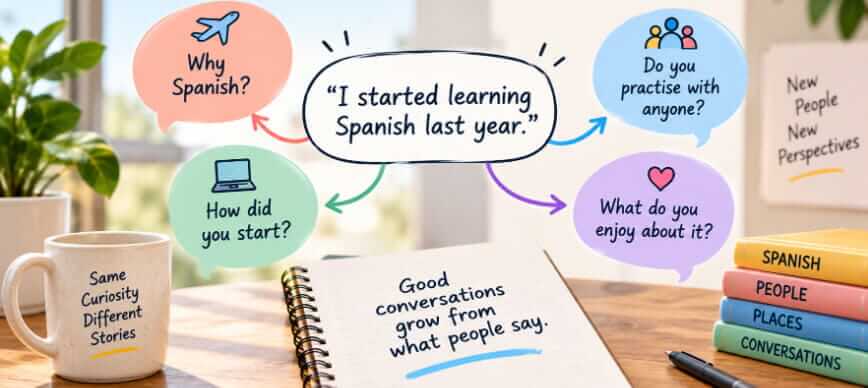
“I started learning Spanish last year because I went to Madrid.”
There are several directions you could take.
You could ask:
“Why did you decide to learn Spanish?”
Or:
“How was Madrid?”
Or:
“Was that your first time in Spain?”
Or:
“Do you still study Spanish now?”
You didn’t need to invent a new topic.
The other person already gave you several.
Think of someone’s answer as giving you little doors you can open.
Listen → notice a detail → follow it.
This is much easier than constantly thinking:
“What should I ask next?”
Let Their Answer Give You the Next Question
You don’t need to prepare ten questions before a conversation.
In fact, trying to remember a list of questions can make a conversation feel like an interview.
Instead, try this:
Listen to the answer. Pick one part of it. Ask about that part.
For example:
Them:
“I work in a hotel.”
Instead of immediately changing the subject:
You:
“Do you like your job?”
They might say:
“Yeah, most of the time. I meet people from lots of different countries.”
Now you have another opening:
“That’s interesting. Which countries do most of your guests come from?”
Maybe they answer:
“Mostly Germany and France.”
Now you can continue:
“Do you speak any German or French with them?”
The conversation is moving because each answer creates the next opportunity.
You are not carrying the whole conversation in your head.
You are simply responding to what is happening.
Don’t Turn the Conversation Into an Interview
There is another problem, though.
Once learners discover follow-up questions, they can sometimes ask too many.
It becomes:
- “Where are you from?”
- “What do you do?”
- “How long have you lived there?”
- “What do you like?”
- “What are your hobbies?”
- “What did you do yesterday?”
The other person answers, and you immediately ask another question.
Technically, the conversation continues.
But it doesn’t feel very natural.
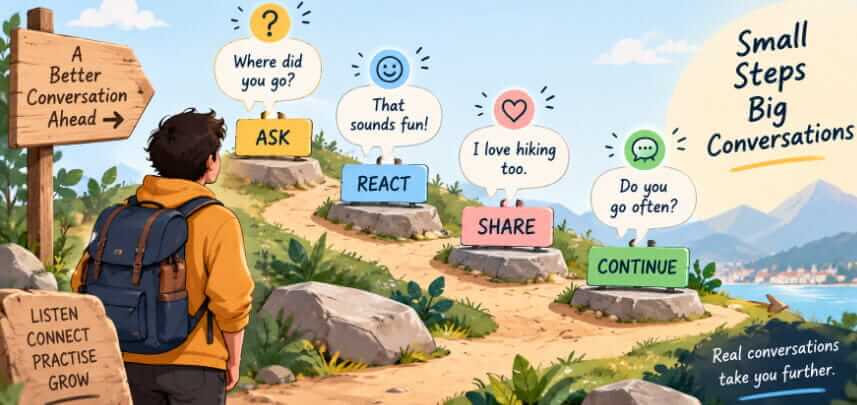
A better pattern is:
Ask → React → Share → Ask
For example:
Them:
“I went hiking last weekend.”
You:
“Really? That sounds nice. Where did you go?”
Them:
“To a place about two hours from here.”
You:
“Nice. I love hiking too, although I usually give up after the first hour.”
Them:
“😂 Same! We actually got lost for a while.”
Now you have another natural opening:
“You got lost? What happened?”
Notice what happened.
You didn’t just keep asking questions.
You reacted and shared something about yourself, too.
That’s what makes a conversation feel like a conversation rather than an interview.
You Can Talk About Yourself Too
Some language learners become so focused on asking questions that they forget they are also part of the conversation.
You don’t have to wait for the other person to ask about you.
If someone tells you:
“I love cooking.”
You can ask:
“What do you like cooking?”
But you can also say:
“I like cooking too, although I mostly make simple Indian food.”
Now you’ve given the other person something to respond to.
They might ask:
“What kind of Indian food?”
And suddenly the conversation has moved naturally.
Remember:
A conversation has two people in it.
You don’t have to keep it alive entirely through questions.
What If You Don’t Know What to Say?
Sometimes you understand everything the other person said.
You know the words.
You know the meaning.
But you still don’t know how to respond.
This is different from not knowing a particular word.
You simply don’t know what would be natural to say next.
When that happens, start with a simple reaction.
Try:
- “Really?”
- “Oh, nice.”
- “That sounds difficult.”
- “That’s interesting.”
- “I didn’t know that.”
- “Same here.”
- “I’ve never tried that.”
These aren’t complicated sentences, but they give you a moment to think.
Then you can follow with a question or share something of your own.
For example:
Them:
“I’ve never been to India.”
You:
“Really? You should come sometime. Which part would you like to visit?”
You don’t need a perfect response.
You just need to keep the door open.
Change the Topic Naturally
Sometimes a conversation really does reach the end of a topic.
That’s normal.
You don’t need to force it.
The easiest way to change subjects is often to move sideways from what you are already discussing.
For example:
Work
→ commute
→ public transport
→ cities
→ travel
→ countries you’ve visited
Or:
Food
→ cooking
→ restaurants
→ favourite dishes
→ family meals
→ childhood memories
You don’t have to suddenly say:
“Anyway, what is your favourite movie?”
You can move gradually.
The current topic often contains the next topic.
Small Talk Is Real Conversation Practice
Small talk sometimes gets a bad reputation.
People think it is boring or meaningless.
But for a language learner, ordinary conversation can be extremely useful.
When you talk about everyday things, you repeatedly practise the language people actually use:
- “How was your day?”
- “What are you doing this weekend?”
- “Did you watch anything good recently?”
- “How’s work going?”
- “What have you been up to?”
These conversations may not seem impressive.
But they give you repeated practice with listening, responding, asking questions, reacting, and sharing.
And that is exactly what you need when learning to communicate with real people.
Learn Conversation Phrases, Not Just Individual Words
Knowing individual words is useful.
But conversations also run on small phrases that you can use again and again.
For example:
- “How about you?”
- “What do you mean?”
- “What happened next?”
- “Really? Why?”
- “That reminds me…”
- “I’ve never tried that.”
- “I’ve had the same experience.”
- “How did you get into that?”
- “What was it like?”
- “And then what happened?”
These phrases don’t have to be complicated.
Their value comes from helping you react quickly and naturally.
Instead of building every sentence from zero, you start recognizing useful patterns you can bring into real conversations.
It’s Okay to Pause
You don’t have to answer immediately.
A short pause doesn’t mean you failed.
Sometimes you simply need a second to find your words.
You can also use a simple phrase to give yourself a little more time:
- “Let me think…”
- “Hmm, how can I explain this?”
- “That’s a good question.”
- “I never thought about that.”
These phrases are useful because they allow the conversation to continue while you think.
You are not required to sound perfectly fluent every second.
Don’t Prepare the Whole Conversation in Your Head
Preparing a few questions before speaking can be helpful.
Trying to prepare the entire conversation usually isn’t.
Why?
Because real people don’t follow scripts.
You might prepare:
“Where are you from?”
They answer:
“I’m from Brazil.”
You planned to ask:
“What do you do?”
But then they mention that they moved there last year.
Now the conversation has changed direction.
If you’re only following your prepared questions, you may miss the opportunity.
Instead, prepare a few useful tools, not an entire script.
Know how to:
- ask a follow-up question
- react to an answer
- share something about yourself
- ask for clarification
- change the subject
- buy yourself a little thinking time
Then let the conversation develop naturally.
A Simple Conversation Ladder
When you don’t know what to do next, remember this:
1. Listen
Pay attention to what the person actually says.
2. Notice
Find one detail that interests you.
3. Follow up
Ask something about that detail.
4. React
Show that you heard them.
5. Share
Add something about yourself.
6. Continue
Use their response to move forward.
For example:
Them:
“I started running this year.”
You:
“Really? Why did you start?”
Them:
“I wanted to get healthier.”
You:
“That makes sense. I’ve been trying to exercise more too. Do you run every day?”
Now you aren’t searching for a completely new subject.
You’re simply following the conversation.
Practise Keeping a Conversation Going
You can practise this even without having a long conversation.
Take a simple statement:
“I watched a movie last night.”
Now give yourself three possible follow-ups:
- “What movie did you watch?”
- “Did you like it?”
- “Do you usually watch movies at home?”
Then add something about yourself:
“I’ve been watching more movies lately because I’m trying to improve my listening.”
Try the same exercise with:
- “I went to a restaurant yesterday.”
- “I’m learning Japanese.”
- “My brother lives in Canada.”
- “I started a new job.”
- “I’m going on holiday next month.”
The goal isn’t to create perfect sentences.
The goal is to train yourself to see possibilities inside an answer.
When the Conversation Gets Quiet
Even good conversations sometimes become quiet.
That’s normal.
You can go back to something the person mentioned earlier.
For example:
“You mentioned earlier that you like photography. What kind of photos do you take?”
Or:
“By the way, how did that meeting go?”
You can also introduce something from your own life:
“Something funny happened to me today…”
Or simply change direction:
“Speaking of that, have you ever…?”
You don’t always have to rescue the conversation with an amazing question.
Sometimes a simple opening is enough.
Real Conversations Won’t Always Be Smooth
Some conversations will flow easily.
Others won’t.
Sometimes the other person is tired.
Sometimes they are shy.
Sometimes you don’t have much in common.
Sometimes you misunderstand each other.
And sometimes you simply run out of things to say.
That doesn’t mean your language is bad.
Even native speakers have awkward conversations.
The goal isn’t to make every conversation perfect.
The goal is to become more comfortable participating in one.
Every conversation gives you another chance to practise listening, reacting, asking, explaining, and finding your words.
Start Small
You don’t have to hold a one-hour conversation to practise this skill.
Start with five minutes.
Choose one person.
Ask one question.
Listen carefully.
Pick one detail from their answer.
Follow it.
Share something about yourself.
Then do it again.
Over time, you’ll start noticing something important:
You don’t need to have the whole conversation planned before you begin.
You only need to know what to do with the next part of it.
Keep the Conversation Moving
Keeping a conversation going in another language isn’t really about having hundreds of clever questions ready.
It’s about paying attention.
Listen to the answer.
Notice a detail.
Ask about it.
React.
Share something.
Let the topic move naturally.
And if you don’t know what to say, pause for a moment and start with something simple.
The more real conversations you have, the more familiar this process becomes. You stop trying to control every sentence and start responding to the person in front of you.
If you’d like more opportunities to practise, explore Pep Talk Radio’s upcoming language events and join a conversation with real people who are learning, practising, and communicating across languages.
You don’t need to know exactly what you’re going to say.
Listen to what comes next.
Then keep the conversation going.