How to Think and Respond Faster When Speaking Another Language
You understand the question. You know the words. You may even know exactly what you want to say.
Then the other person stops talking, and suddenly you can’t find the words.
You search your memory. You think about the grammar. You translate part of your answer in your head. You wonder whether what you’re about to say sounds natural. A few seconds pass, and you are still trying to begin.
If this happens to you, it doesn’t necessarily mean you don’t know enough of the language.
There is a difference between knowing a language and being able to use it in real time.
You might recognize a word immediately when you read it but struggle to remember it when you’re speaking. You might understand a grammar rule in an exercise but hesitate when you need to use it in a conversation.
That is one reason speaking can feel much harder than studying.
The good news is that this is a skill you can practice. You can get better at finding the language you already know and using it while a conversation is happening.
Why Knowing a Language Isn’t Always Enough
When you study a language, you spend a lot of time recognizing it.
You see a word and know what it means. You read a sentence and understand it. You hear a familiar expression and recognize it.
Speaking asks you to do something different.
Imagine someone asks:
“What did you do after work yesterday?”
You may understand every word in the question.
Now you have to produce your own answer:
“I went home, made dinner, and watched a movie.”
You have to find the words, put them together, and say them while the conversation is happening.
That difference is easy to notice in language conversation practice. A learner can understand a question perfectly and still need a few seconds to find the words for an answer. It doesn’t mean the learner hasn’t learned the language. Often, it means they need more practice using what they already know.
At Pep Talk Radio, this is one of the reasons we focus on real conversation. Learning gives you the building blocks, but conversation gives you a chance to use them.
Speaking Faster Doesn’t Mean Talking Faster
When language learners say they want to speak faster, they usually don’t mean they want to talk as quickly as possible.
They want to stop getting stuck.
They want familiar words to come to mind more easily. They want to answer without constructing every sentence in their head first. And when they forget a word, they want to keep talking instead of losing the conversation.
So don’t think of speaking faster as talking faster.
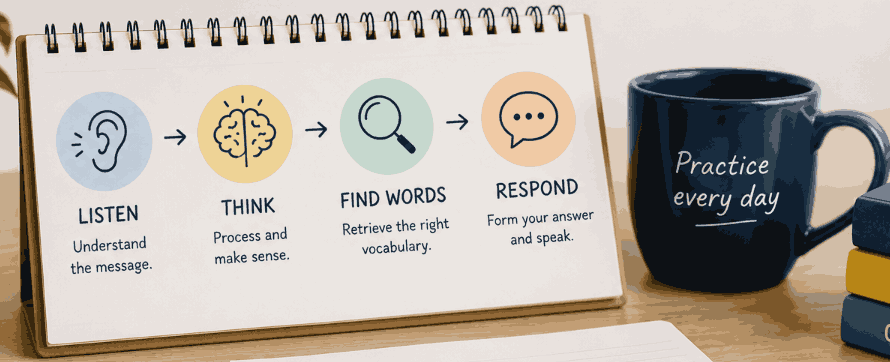
Think of it as becoming more comfortable moving from:
understanding → finding the language → responding
You will still pause sometimes. Fluent speakers pause too.
The difference is that a pause becomes a normal part of thinking rather than a moment when you feel you’ve completely lost your ability to speak.

Start With Short Answers
If you often freeze when someone asks you a question, don’t begin by trying to give a long or impressive answer.
Start with something simple.
Someone asks:
“Where do you live?”
You say:
“I live in Delhi.”
Then add a detail:
“I live in Delhi. I’ve lived here for several years.”
You can add another:
“I live in Delhi. I’ve lived here for several years, and I like the energy of the city.”
Then you can turn it into a conversation:
“What about you?”
This is a useful way to practice because you’re taking language you already know and building with it.
You don’t need advanced vocabulary to have a meaningful conversation. A simple answer can become a longer one when you add a detail, a reason, an example, or a question.
Try the Same Question More Than Once
You can practice this without a conversation partner.
Ask yourself:
“What did you do yesterday?”
Answer out loud without preparing first.
Then answer the same question again.
The second attempt may feel easier because you’ve already found some of the words and worked out what you want to say. You may also notice that you can express the same idea more naturally.
Try this with everyday questions:
What do you normally do after work?
What are you learning at the moment?
What did you do last weekend?
What kind of food do you like?
What are you planning to do tomorrow?
You’re not memorizing answers. You’re getting more comfortable talking about familiar subjects without having to build everything from the beginning each time.
Try a 30-Second Speaking Challenge
Choose a simple topic and talk about it for 30 seconds.
You could talk about your hometown, your work, your family, a hobby, something you watched recently, or something you did that day.
Set a timer and start speaking.
Don’t write a script first. Don’t stop every few seconds to correct your grammar.
If you forget a word, explain the idea another way. If you make a small mistake, keep going.
When the 30 seconds are over, try again.
Once 30 seconds becomes comfortable, increase it to one minute.
This exercise is not about showing how much vocabulary you know. It is about getting used to keeping your thoughts moving in the language you’re learning.
Practice Questions You Haven’t Prepared For
Real conversations don’t always stay on familiar ground.
Someone might ask:
“What’s something you’d never do?”
Or:
“If you could live anywhere, where would you go?”
Or:
“What makes someone a good friend?”
You probably won’t have a prepared answer. Take a moment and say what you can.
You might say:
“I’ve never really thought about that, but…”
That’s a perfectly normal way to begin.
What makes this useful is that you’re practicing something normal exercises don’t always give you: deciding what you want to say while the conversation is happening.
You don’t need to give an impressive answer. You need to practice responding.
Don’t Let One Missing Word Stop You
Forgetting a word can make you feel as if you suddenly can’t speak the language.
Try describing the idea instead.
Suppose you want to say:
“I was exhausted.”
But you can’t remember exhausted.
You can say:
“I was really tired.”
You forget neighborhood?
Try:
“The area where I live.”
You forget appointment?
You could say:
“I had a meeting with my doctor.”
This is an important part of speaking.
You don’t always need the exact word. You need a way to communicate the idea.
Once you get used to doing this, a missing word becomes less of an emergency. You can explain, describe, give an example, or use a simpler word and continue.
That ability can make a big difference in real conversation.
Give Yourself Time to Think
You don’t have to answer every question immediately.
People pause when they speak their own language. They think, search for words, change their minds, and sometimes start a sentence again.
You can do the same when speaking another language.
Expressions such as these can give you a moment:
“Let me think.”
“That’s a good question.”
“I’m not sure, but…”
“I think…”
“Well, actually…”
You don’t need to use these expressions constantly. The more important thing is becoming comfortable with the idea that a few seconds of thinking are normal.
A pause doesn’t mean the conversation has failed.
Stop Trying to Make Every Sentence Perfect
Trying to be accurate is a good thing. Trying to make every sentence perfect before you say it can slow you down.
You might start speaking, notice a grammar question, stop to correct yourself, rethink the sentence, and then start again.
Meanwhile, the conversation has moved on.
Grammar and pronunciation still matter. The point isn’t to ignore mistakes. It’s to give communication some room while you’re practicing.
If someone asks:
“Did you enjoy the movie?”
you can simply say:
“Yes, I really liked it. The story was interesting.”
You don’t need to find a more complicated answer.
When you’re practicing speaking, it can be more useful to finish your thought and think about one improvement afterward than to interrupt yourself every few seconds.
Learn to Keep a Conversation Going
Speaking isn’t only about answering questions. It’s also about giving the other person something to respond to.
Imagine someone says:
“I went to Spain last month.”
You could say:
“Nice.”
And stop there.
Or you could ask:
“How was it?”
“Which part of Spain did you visit?”
“What did you like most?”
Now the conversation has somewhere to go.
Follow-up questions are useful when you’re not sure what to say next. They also remind you that a conversation is shared. You don’t have to carry it by yourself.
Simple questions such as “What about you?”, “Why?”, “How was it?”, and “What happened next?” can keep a conversation going surprisingly well.
Practice Without Memorizing a Script
Preparing useful language for common situations can help, especially when you’re starting out.
But try not to depend on complete, memorized answers.
Suppose you want to practice talking about your work.
Instead of memorizing a paragraph, think about three things:
- what you do
- what you like about it
- what you find difficult
Then talk about those ideas in your own words.
Your sentences can change every time.
That is useful because real conversations rarely follow a script. You need to be able to express the same idea in different ways.
Record Yourself and Try Again
Your phone can be a simple speaking-practice tool.
Choose a question and record yourself answering it for about a minute.
Then listen once.
Don’t try to find every mistake. Listen for one thing.
Maybe you paused whenever you needed a particular word. Maybe your answers were very short. Maybe you repeated the same expression several times. Maybe you noticed a pronunciation problem.
Then answer the same question again.
This time, pay attention to that one thing.
The second attempt can feel quite different because you already know what you want to say.
The purpose isn’t to judge your speaking. It’s to notice what happens when you actually use the language.
Practice With Real People
Practicing alone gives you control. You can choose the topic, stop whenever you want, repeat a sentence, and take your time.
Real conversation is different.
Another person may ask something you didn’t expect. They may use an expression you’re not familiar with. They may change the subject. You have to listen, understand what they mean, decide what you want to say, and respond.
That can be difficult, but it’s also what makes conversation valuable practice.
Through the kind of language conversation practice Pep Talk Radio is built around, this difference becomes clear. A learner may know plenty of vocabulary and grammar but still find it difficult to respond when the conversation moves in an unexpected direction.
That isn’t necessarily a sign that they need to study more. Sometimes they need more opportunities to use what they’ve already learned.
Real conversation gives you those opportunities.
A Simple 10-Minute Speaking Routine
You don’t need an hour every day to practice speaking. Ten focused minutes can give you a useful start.
Minutes 1–2: Answer easy questions
Choose a few familiar questions:
Where do you live?
What do you normally do in the evening?
What did you do yesterday?
Answer them out loud.
Minutes 3–5: Talk about one topic
Choose one subject and keep talking.
If three minutes feels too difficult, start with 30 seconds and build up gradually.
Minutes 6–7: Try again
Talk about the same topic again.
Notice whether some words or ideas come more easily the second time.
Minutes 8–9: Try unexpected questions
Choose questions you haven’t prepared for.
Give yourself a moment to think, then answer.
Minute 10: Choose one thing to work on
Think about what you noticed.
Maybe you struggled to find vocabulary. Maybe you stopped too often. Maybe you found it difficult to continue after answering a question.
Choose one of those things to focus on during your next practice session.
A routine doesn’t have to be complicated to be useful. The important part is doing it regularly.
Focus on the Problem You Actually Have
Different learners get stuck for different reasons.
If you know what you want to say but can’t find the words, practice retrieving and using familiar vocabulary.
If you understand questions but don’t know how to continue, practice asking follow-up questions.
If you stop whenever you make a mistake, practice finishing your thought before correcting yourself.
If you can talk about familiar topics but freeze when someone asks something unexpected, practice more unscripted questions.
And if you mostly study alone, look for opportunities to have real conversations.
You don’t need to improve everything at once. Find the part of speaking that gives you the most trouble and work on that first.
Notice the Small Signs of Progress
Speaking progress isn’t always dramatic.
You may still pause, but recover more quickly.
You may still forget words, but now you can explain what you mean.
You may still make grammar mistakes, but you’re able to continue talking.
You may find that a question that used to make you freeze now feels familiar.
These changes are easy to overlook because you’re usually thinking about what you still can’t do.
Instead, pay attention to what has become easier.
Being able to communicate a little more comfortably is progress, even if you don’t suddenly feel fluent.
You Don’t Have to Wait Until You’re Ready
It’s easy to think:
“I’ll start speaking when I know more.”
So you learn more vocabulary. You study more grammar. You finish another course.
And you still don’t feel ready.
At some point, speaking has to become part of the learning process itself.
You learn to respond by responding. You become better at handling unexpected questions by having unexpected conversations. You learn to recover from mistakes by making them and continuing.
You can start with the language you have now.
You don’t need to wait until you feel completely confident.
Put What You Know Into Practice
Learning vocabulary and grammar gives you the building blocks of a language. Speaking teaches you how to use those building blocks when someone is actually talking to you.
That’s why speaking practice isn’t simply about learning more. It’s about making it easier to understand, respond, explain, ask, listen and continue.
Start with short answers. Repeat familiar questions. Talk about everyday topics. Try questions you haven’t prepared for. Learn to work around words you forget. Give yourself time to think, and when you can, practice with real people.
You don’t have to speak perfectly.
You don’t have to speak quickly.
You need regular opportunities to turn what you know into something you can actually use.
Understand. Retrieve. Respond. Continue.
That’s what real speaking practice is about.
Take the Next Step: Use the Language With Real People
Solo speaking exercises can help you prepare, but real conversations give you something different. You have to listen to another person, respond to what they actually say, deal with unexpected questions, and find another way to express yourself when a word doesn’t come to mind.
If you’re looking for a place to put this into practice, Pep Talk Radio brings language learners together for online conversations where you can listen, respond, make mistakes, and keep talking.