
Time vs. Energy Management: How to Find the Right Time to Learn a Language

You may have more time to learn a language than you think.
The problem is that your free time and your best learning time aren’t always the same thing.
Maybe you finish work at 8 p.m. and tell yourself you’ll finally study Spanish for an hour. You sit down, open your laptop, look at the lesson, and realize your brain has had enough for the day.
You have the time.
You just don’t have much energy left.
Then you start wondering whether you lack discipline, motivation, or consistency.
Sometimes, you don’t.
You may simply be trying to do the wrong kind of language practice at the wrong time of day.
This is where thinking about energy, not just time, can change the way you learn.
Free Time Isn’t Always Useful Learning Time
When people create a language-learning routine, they often start with their calendar.
“I have an hour after work.”
“So I’ll study for an hour after work.”
It sounds reasonable.
But an hour of language practice when you’re alert isn’t necessarily the same as an hour when you’re mentally exhausted.
Language learning asks different things from your brain depending on what you’re doing.
Reading a simple article isn’t the same as having a conversation.
Reviewing familiar vocabulary isn’t the same as trying to understand a fast conversation.
Watching something casually isn’t the same as writing in a language you’re still learning.
So instead of asking only:
“When am I free?”
try asking:
“What kind of language practice can I realistically handle when I’m free?”
That small change can make your routine much easier to maintain.
Different Language Activities Need Different Levels of Attention
You don’t need the same amount of concentration for everything you do in a language.
Think about a real conversation.
Someone says something you didn’t expect.
You have to understand them.
Then you have to find the words you need.
Then you have to put together a response.
And while you’re doing all that, the other person is waiting.
That’s very different from reviewing ten words you’ve already seen several times.
This is why it can help to match the activity to the amount of energy you have.
When you’re feeling fresh
This can be a good time for activities that require active attention:
- having a conversation
- speaking practice
- writing
- pronunciation work
- difficult grammar
- challenging listening
- working with new vocabulary
If speaking is one of your main goals, your more alert periods are worth protecting for actual communication when possible.
When your energy is moderate
You might choose activities such as:
- reading
- watching a video in your target language
- listening to a podcast
- reviewing vocabulary
- working through a lesson
- revisiting something you studied earlier
You’re still doing active language work, but you may not need quite the same level of concentration.
When you’re tired
You don’t necessarily have to abandon the language completely.
You could:
- listen to music
- watch something familiar
- replay a podcast
- listen to a short conversation
- review words you already know
- spend a few minutes noticing expressions you hear
This isn’t about pretending that every five-minute activity is equal to serious practice.
It isn’t.
It’s about recognizing that different kinds of contact with a language make sense at different moments.
Your Best Time for Speaking May Not Be Your Most Convenient Time
This matters especially if your goal is to become comfortable speaking.
Imagine you have a language conversation session at the end of a long working day.
You wanted to practise.
You had the time.
But you’ve spent the entire day concentrating, answering questions and communicating with other people.
By the time the conversation begins, you’re mentally tired.
You might struggle to find words you actually know.
You may understand less than usual.
You may speak more slowly.
That doesn’t necessarily mean you’ve suddenly become worse at the language.
You may simply be tired.
If you have some control over your schedule, try experimenting with different times for speaking.
Perhaps you’re more comfortable speaking in the morning.
Perhaps your lunch break works better.
Perhaps weekends give you enough mental space for longer conversations.
There isn’t one universally perfect time.
Your best time is the time when you can actually participate.
Don’t Spend Your Best Energy on the Easiest Task
This is an easy mistake to make.
Suppose you know that you’re most alert in the morning.
You have 30 minutes.
You could spend those 30 minutes scrolling through vocabulary you already know.
Or you could use them for something you’ve been avoiding because it requires more concentration: speaking, writing, pronunciation or difficult listening.
Then later, when your energy drops, you can do something lighter.
For example:
Morning: conversation practice
Commute: listening
Lunch break: vocabulary review
Evening: reading or watching something enjoyable
You don’t have to follow this exact routine.
The point is simply to ask:
Which language activity deserves my attention right now?
Your Commute Can Be Useful — Without Becoming Another Study Session
Not every part of your day needs to become a serious lesson.
If you’re travelling to work, walking somewhere or doing something that allows you to listen, you might have an opportunity to bring the language into your day.
You could listen to:
- a podcast
- a conversation
- music
- an audiobook
- a video you don’t need to watch closely
Sometimes you’re actively studying.
Sometimes you’re simply listening.
Both can have a place in your routine.
The important thing is not to turn every spare minute into homework.
Language learning should eventually become part of your life, not something that exists only when you are sitting at a desk.
When You’re Too Tired to Speak, Change the Activity
There will be days when you don’t have the energy for a conversation.
That’s normal.
You don’t have to force yourself through a speaking session just because it was written on your calendar.
Maybe today is better for listening.
Maybe you can read something short.
Maybe you can watch an episode of a show you’ve already started.
Maybe you can review a few expressions.
And sometimes you really do need to do nothing.
The important distinction is between changing the type of practice and constantly avoiding the practice you need.
If you always say you’re too tired to speak, even when you’re not, that’s something worth noticing.
But if you genuinely had a difficult day and choose a lighter activity once in a while, that’s simply being realistic.
Short Practice Still Counts
A common language-learning trap is thinking that a session only counts if it is long.
“I only have fifteen minutes.”
“So there’s no point.”
There is.
Fifteen minutes of focused listening is still listening.
Ten minutes of speaking is still speaking.
A short conversation is still a conversation.
Even a few minutes spent reading something interesting in your target language keeps you in contact with it.
The question isn’t always:
“How many minutes did I study?”
Sometimes a better question is:
“What did I actually do with the language?”
A short session where you actively communicate can be much more meaningful than a long session where you’re exhausted and barely paying attention.

Build a Routine for Your Real Life
Your language-learning routine has to fit the life you actually have.
If you work long hours, your routine will be different from someone who studies full-time.
If you have children, your schedule will look different.
If you commute, listening might naturally become part of your day.
If weekends are quieter, perhaps that’s when you arrange longer conversations.
There is no prize for creating the most impressive timetable.
A simple routine that you can continue for months is far more useful than a perfect schedule that lasts for five days.
Instead of asking:
“What is the ideal language-learning routine?”
ask:
“What routine can I realistically keep doing?”
Try Matching Practice to Your Energy
You don’t need a complicated system.
For one week, simply notice how your energy changes throughout the day.
Then experiment with different activities.
You might discover something like this:
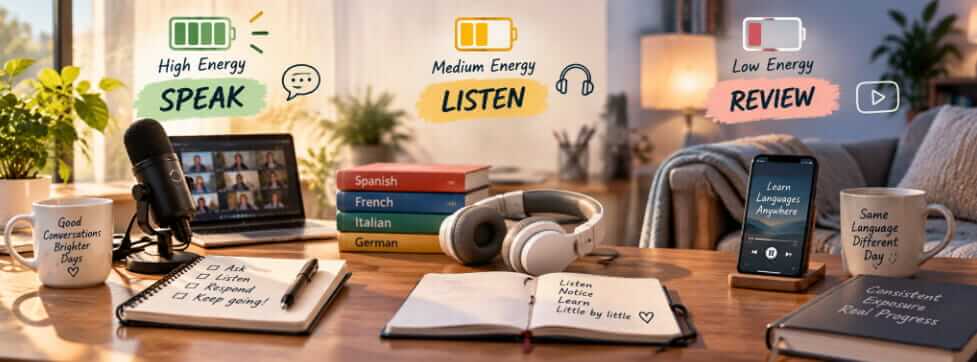
High energy → speaking or challenging study
Medium energy → reading, listening or vocabulary
Low energy → music, familiar videos or light review
Don’t treat this as a fixed formula.
You may find that you actually enjoy reading when you’re tired, or that listening requires more concentration for you than expected.
That’s useful information.
The goal is to understand your own learning rhythm.
Once you know it, you can stop fighting against it.
Give Real Conversations Some of Your Best Energy
If your goal is to communicate comfortably in another language, studying alone can only take you so far.
You eventually need to listen to real people.
You need to respond to things you didn’t prepare for.
You need to search for a word while someone is waiting for your answer.
You need to discover that conversations don’t follow the neat examples in a textbook.
That kind of practice is valuable precisely because it is unpredictable.
So if real conversation is important to your goal, don’t always leave it for the moment when you have nothing else to do and almost no energy left.
When possible, give it a place in your week when you can actually be present.
You don’t need to have a long conversation every day.
But you do need opportunities to use the language with another person.
Don’t Turn Language Learning Into Another Source of Guilt
There is already enough pressure in everyday life.
You don’t need to turn language learning into another reason to feel guilty.
You missed yesterday’s study session?
Continue today.
You were too tired to finish the lesson?
Try something shorter.
You had a busy week?
Start again.
Your routine doesn’t have to be perfect to be useful.
In fact, a routine that leaves room for busy days, tired days and unexpected changes is probably more realistic than one that assumes every day will go according to plan.
Consistency doesn’t mean doing exactly the same thing every day.
Sometimes consistency means coming back to the language again and again.
Time Still Matters
Energy management isn’t an argument against managing your time.
You still need time to learn.
But time alone doesn’t tell you what you can realistically accomplish.
You might have two free hours at the end of a long day and struggle to concentrate.
You might have twenty minutes in the morning and have a surprisingly productive conversation.
The difference isn’t necessarily discipline.
It’s context.
Your available time, your energy, your environment and the type of practice you’re doing all matter.
That’s why a useful language routine isn’t simply a timetable.
It’s a way of deciding what kind of practice makes sense at different moments in your life.
Learn With the Energy You Actually Have
You won’t always feel ready to study.
You won’t always have enough energy for a conversation.
Some days you’ll be excited to learn.
Other days you’ll only have enough energy to listen to something while you make dinner or travel home.
That’s part of learning a language alongside a real life.
When you’re alert, use that energy for the things that need your attention.
When you’re tired, choose something lighter.
When you have only ten minutes, use those ten minutes.
And when you genuinely need to rest, rest.
You don’t need endless free time to make progress in a language.
You need to keep finding realistic ways to meet the language, use it and come back to it.
Over time, those small moments add up — especially when some of them involve real people, real conversations and the language being used for something more than simply completing another lesson.