
How to Practice Speaking a Language When You Have Nobody to Talk To
You know you need to speak more, but there’s a problem: you don’t have anyone to speak with.
Maybe your friends and family don’t speak the language. Maybe you haven’t found a language partner yet. Or maybe you simply don’t feel ready to join a conversation group.
You can still practice.
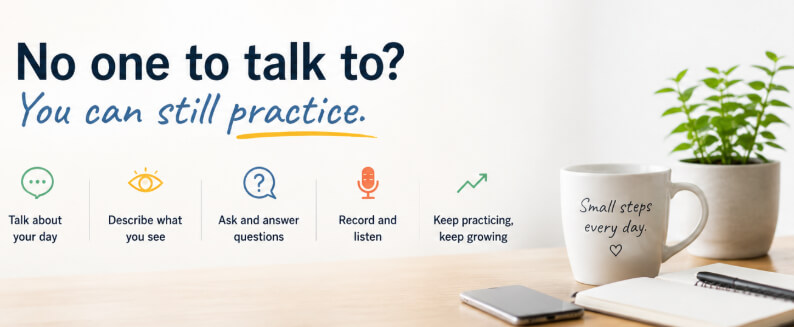
You don’t need another person every time you want to improve your speaking. You can talk about your day, answer questions, describe what you see, retell stories, and record yourself.
These exercises won’t replace real conversations. But they can help you become more comfortable finding words and expressing your thoughts when you eventually speak with someone.
The goal isn’t to practice alone forever. It’s to use the time you have to build speaking skills until you have more opportunities to use the language with other people.
Turn Everyday Moments Into Speaking Practice
You don’t need a special topic or a lot of free time.
Use ordinary moments during your day.
While making breakfast, getting ready, walking, cooking, or working, describe what you’re doing in your target language.
Start simply:
“I’m making coffee.”
Then add another thought:
“I’m making coffee because I’m tired this morning.”
Then continue:
“I’m making coffee because I’m tired this morning. I have a lot of work to do today.”
The sentences don’t need to be complicated. The goal is to practice turning your thoughts into words.
You can do this for a few minutes whenever you have time.
Describe What You See
Look around you and choose something to describe.
For example:
“There is a table.”
Then add some detail:
“There is a small table next to the window.”
Then make it personal:
“I usually keep my books on this table.”
You can do this with almost anything—a room, a street, a shop, or a park.
If you forget a word, describe it instead of stopping.
That is useful practice because you won’t always remember the exact word you need in a real conversation either.

Ask Yourself Questions
Think of questions someone might ask you in a normal conversation:
- Where are you from?
- What do you do?
- Why are you learning this language?
- What did you do today?
- What do you usually do on weekends?
- What kind of food do you like?
- What are you planning to do tomorrow?
Answer them out loud.
Start with a short answer:
“I’m learning Spanish.”
Then expand it:
“I’m learning Spanish because I enjoy the language.”
Then add another idea:
“I’m learning Spanish because I enjoy the language, and I’d like to have conversations with Spanish speakers.”
This helps you practice moving from a quick answer to a fuller response.
Give Yourself Follow-Up Questions
Real conversations don’t usually stop after one answer.
If someone asks:
“Why are you learning Spanish?”
you might answer:
“Because I enjoy the language.”
They could then ask:
“What do you like about it?”
You can practice this by yourself.
After answering a question, ask:
Why? What? When? Where? How?
For example:
“I like watching football.”
Why?
“Because I enjoy watching it with my friends.”
When?
“Usually on weekends.”
Where?
“We normally watch it at home.”
You’re creating a simple conversation without needing another person.
Retell Something You Know
Watch a short video, read something, listen to a story, or think about something that happened during your day.
Then put it away and explain what you remember.
Don’t try to repeat it word for word. Tell it in your own way.
For example:
“I watched a video about someone who moved to another city. At first, he didn’t know many people. Then he joined a local group and started meeting people.”
If you forget a word, keep going. Find another way to express the idea.
This is useful because you’re practicing how to communicate your own thoughts rather than simply repeating someone else’s sentences.
Don’t Let One Missing Word Stop You
You know what you want to say, but you can’t remember one word.
Instead of stopping completely, explain the idea.
If you forget “neighborhood,” you could say:
“The area where I live.”
If you forget “receipt,” you could say:
“The piece of paper they give you after you buy something.”
If you forget “borrow,” you could explain:
“When you take something from someone and give it back later.”
This is called circumlocution—using other words when you can’t remember the exact one.
It’s a useful speaking skill because communication doesn’t have to stop just because your vocabulary isn’t perfect.
Record Yourself for 30 Seconds
Use your phone.
Choose one simple topic and speak for 30 seconds.
Don’t write a script first. Just speak.
Then listen to yourself.
Notice:
- Where did you hesitate?
- Which words were difficult to find?
- Did you stop because of one missing word?
- Did you switch to your first language?
- Could you explain something more simply?
Then try again.
You may find that the second attempt feels easier because you’ve already organized your thoughts once.
When 30 seconds feels comfortable, try one minute.
Repeat Instead of Always Starting Something New
You don’t need a new topic every day.
Talk about the same subject several times.
For example, speak about your weekend today.
Tomorrow, talk about your weekend again.
The first attempt might be difficult. The next one may come more naturally.
You can also change the challenge:
- speak for 30 seconds
- speak for one minute
- explain the topic differently
- answer imaginary follow-up questions
Repeating a topic gives you more chances to retrieve the same language and use it in different ways.
Try Shadowing
Shadowing means listening to a short piece of speech and repeating it shortly afterward.
Try to follow the speaker’s pronunciation, rhythm, and intonation.
It can be useful for getting your mouth used to the sounds and rhythm of the language.
But remember: shadowing is not a conversation.
You’re repeating someone else’s words rather than deciding what you want to say.
Use it as one part of your speaking practice, not the whole practice.
Use AI When You Need More Practice
If you don’t have a speaking partner, an AI chatbot can help you create more opportunities to practice.
You can ask it to:
- ask you questions
- role-play an everyday situation
- give you a speaking topic
- ask follow-up questions
- practice a difficult conversation
- give feedback after you finish speaking
For example, you could ask it to pretend you’ve just met someone for the first time and have a short conversation with you.
That can be useful when you don’t know what to practice.
But AI has limits.
A real person may interrupt you, misunderstand you, change the subject, use an expression you don’t know, or answer in an unexpected way.
Those situations are part of real communication.
Try This 10-Minute Routine
You don’t need an hour.
Try ten minutes.
Minutes 1–2: Describe
Talk about what you’re doing or what you can see.
Minutes 3–5: Answer questions
Choose three everyday questions and answer them aloud.
Minutes 6–7: Retell
Explain something you watched, read, or experienced.
Minutes 8–9: Keep talking
Choose one topic and speak without stopping. If you forget a word, explain it another way.
Minute 10: Review
Think about one thing that was difficult.
Maybe you couldn’t remember certain words. Maybe you hesitated too much. Maybe you kept translating in your head.
Choose one problem to work on next time.
What Does a Solo Practice Session Look Like?
Suppose you choose the topic “My weekend.”
Start with:
“I stayed home.”
Add another thought:
“I stayed home because I was tired.”
Keep going:
“On Sunday, I cooked lunch and watched a movie.”
Now ask yourself:
“What did I cook?”
“Why did I stay home?”
“What movie did I watch?”
If you forget a word, don’t stop. Explain it another way.
In just a few minutes, you’ve practiced building sentences, answering questions, adding detail, finding vocabulary, and keeping yourself talking.
You can use the same approach with almost any topic.
What Solo Practice Can’t Teach You
Speaking alone can help you practice:
- finding words
- forming sentences
- organizing your thoughts
- speaking for longer
- explaining words you forget
- becoming more comfortable speaking aloud
But real conversations add something different.
You have to listen and respond at the same time. You have to deal with different speaking styles, unexpected questions, unfamiliar expressions, misunderstandings, and changes in direction.
That’s why solo practice is best seen as preparation for conversation, not a replacement for conversation.
You Don’t Have to Wait for a Speaking Partner
Not having someone to talk to can be frustrating, but it doesn’t mean you have to stop practicing.
You can start today with just a few minutes.
Talk about your day. Describe what you see. Answer questions. Retell something you heard. Record yourself. Practice explaining words you forget.
These small exercises help you become more comfortable putting your thoughts into the language.
You don’t have to wait for the perfect speaking partner to start. Practice with what you have, and when you get the chance to speak with real people, use it.
Solo practice prepares you. Real conversations help you learn how to communicate with another person.