Learn Danish Online: A Beginner’s Guide to the Danish Language
Want to learn Danish online but don’t know where to start?
You don’t need to begin with complicated grammar or spend hours memorizing vocabulary. A good beginner routine can combine short lessons, listening, useful phrases, pronunciation practice and, eventually, real conversations.
Danish can feel unusual at first, especially when you hear it spoken. The written language may look fairly familiar, but the pronunciation can be quite different from what a beginner expects.
The good news is that you can start learning Danish from home with a few simple resources and a realistic routine.
This guide introduces you to the Danish language and shows you how to start learning Danish online, even if you’re starting from zero.
A note about Pep Talk Radio’s Danish events: Pep Talk Radio previously hosted online Danish language events, but Danish events are not currently hosted. This page is now a general Danish language-learning resource. If Danish events return in the future, this page may be updated with new information.
What Is the Danish Language?
Danish, or dansk, is the language of Denmark and is spoken by around six million people. It belongs to the Germanic language family and is closely related to Norwegian and Swedish.
The three Scandinavian languages share a long history, so you may notice similarities if you already know Norwegian or Swedish.
That doesn’t mean Danish will automatically be easy, though.
Written similarities can sometimes be helpful, while spoken Danish can be much harder to follow. Pronunciation is one of the things that makes Danish particularly interesting for language learners.
And that’s one reason listening should be part of your Danish learning from the beginning.
Where Is Danish Spoken?
Danish is primarily spoken in Denmark, but the language also has a presence outside the country, including among the Danish minority in northern Germany.
For most people learning Danish, however, the reason to learn it is much more personal than the number of people who speak it.
You might be moving to Denmark, have Danish friends or family, be interested in Danish culture, or simply want to learn a Scandinavian language.
You don’t need a big reason.
Sometimes you just like a language and want to see where it takes you.
Basic Danish Words and Phrases
One of the easiest ways to make a new language feel less intimidating is to learn a few expressions you could actually use.
Hej — Hello / Hi
Tak — Thank you
Ja — Yes
Nej — No
Undskyld — Sorry / Excuse me
Hvordan går det? — How are you? / How is it going?
Hvad koster det? — How much does it cost?
Taler du engelsk? — Do you speak English?
Jeg taler ikke dansk — I don’t speak Danish
Jeg hedder… — My name is…
Jeg kommer fra… — I come from…
These are much more useful when you imagine yourself actually using them.
For example, don’t just memorize Tak = Thank you.
Imagine ordering something, receiving it and saying:
Tak!
Or imagine meeting someone and saying:
Hej! Jeg hedder…
You’re already connecting the language to a real situation.

The Danish Alphabet: Æ, Ø and Å
If you’re coming from English, three Danish letters will probably catch your attention immediately:
Æ Ø Å
Danish uses the Latin alphabet plus these three letters. They are proper letters in their own right, not simply decorative versions of letters you already know.
At first, you don’t need to worry about mastering their pronunciation.
Start by getting comfortable seeing them.
You’ll eventually notice them everywhere:
- æ
- ø
- å
Once they stop looking strange, reading Danish becomes a little less intimidating.
And remember: learning a language isn’t about understanding everything on the first day. Sometimes the first step is simply getting used to seeing and hearing something unfamiliar.
Why Danish Pronunciation Can Be Challenging
This is where Danish can surprise beginners.
You might look at a Danish word and think:
“I recognize those letters. I should know how to pronounce it.”
Then you hear a Danish speaker say it.
And suddenly you’re not quite so sure.
That’s normal.
Danish has sounds and pronunciation patterns that can take time to get used to. One feature you may encounter is stød, a distinctive feature of Danish pronunciation that can be difficult for learners to recognize and produce. Denmark’s official language information describes it as one reason Danish pronunciation can be challenging for people learning the language.
This is why it’s a good idea to listen to Danish from the beginning rather than spending months learning only from written words.
You want your ears to become familiar with the language at the same time as your eyes.
Don’t Try to Sound Danish Perfectly on Day One
When you’re learning pronunciation, it’s easy to become overly focused on getting every sound right.
Try a simpler approach:
Listen → repeat → compare → try again.
Listen to a short word or sentence.
Say it aloud.
Listen again.
Then try it again.
You don’t need to sound like a native speaker immediately. You’re training your ears and your mouth to become comfortable with a new sound system.
That takes time.
And that’s perfectly normal.
Is Danish Similar to Norwegian and Swedish?
Yes, but not enough to treat them as the same language.
Danish, Norwegian and Swedish developed from a shared Scandinavian linguistic history, which means they still have similarities in vocabulary and other aspects of the languages.
If you already know Norwegian or Swedish, that knowledge may give you a useful starting point.
But spoken Danish can still be difficult to understand.
So if you recognize a Danish word because you know Swedish or Norwegian, great.
Use the similarity.
Just don’t assume that understanding written words means you’ll automatically understand a fast Danish conversation.
How to Start Learning Danish Online
You don’t need ten apps, five textbooks and a complicated study schedule.
Start with a few basic elements and give yourself time to get comfortable with them.
1. Learn the Basics
Start with things you’ll actually use:
- greetings
- introductions
- numbers
- days of the week
- common questions
- everyday verbs
- simple sentence patterns
Don’t try to learn hundreds of words at once.
Your first goal is simply to have enough Danish to recognize and produce basic sentences.
2. Listen to Danish Every Day
Listening should become part of your routine early.
At first, you may understand almost nothing.
That’s okay.
Your first goal isn’t to understand every sentence. It’s to become familiar with the sound of Danish.
Then something interesting starts happening.
You recognize a word.
Then another.
Then a phrase.
Eventually, you hear a sentence and understand the general meaning without translating every word.
That takes time, but regular listening helps.
3. Start Speaking Early
You don’t need to wait until you know “enough” Danish.
Say the words you know.
Read short sentences aloud.
Repeat phrases you hear.
Introduce yourself.
Describe what you’re doing.
And if you don’t have anyone to practice with, you can still speak aloud on your own.
For example:
Hej! Jeg hedder…
Hi! My name is…Jeg kommer fra…
I come from…Jeg lærer dansk.
I’m learning Danish.
It may feel simple.
That’s fine.
Simple language that you actually use is more valuable than complicated language that stays inside a notebook.
4. Learn Words in Context
Instead of memorizing isolated vocabulary, connect words to situations.
For example, you could memorize:
kaffe = coffee
But a sentence gives you something more useful:
Jeg vil gerne have en kaffe.
Now you’ve learned a word, a sentence pattern and a possible real-life situation at the same time.
You don’t have to learn every word this way.
But whenever possible, give new vocabulary some context.
5. Don’t Translate Everything
When you hear Danish, it can be tempting to translate every word into English.
That can quickly become tiring.
Try this instead:
Listen → understand the general idea → notice useful words → listen again.
With enough exposure, some expressions will start feeling familiar without requiring a complete mental translation.
That’s an important step in becoming comfortable with a language.
Can You Learn Danish Online for Free?
Yes.
You don’t necessarily need to pay for a course to begin learning Danish.
The City of Copenhagen currently lists free online resources for Danish learners, including Dansk her og nu, a beginner course designed for self-study with texts and conversations related to everyday life. It also lists free resources for improving Danish reading, writing and spelling.
So you can begin learning Danish without immediately paying for a course.
The important part is not to collect every free resource you can find.
Choose one or two resources and actually use them.
A simple resource you use regularly is more useful than a huge collection of websites you never open.
Listening and Pronunciation Practice
Whatever learning method you choose, make sure you’re actually hearing Danish.
This is particularly important because written Danish and spoken Danish can feel quite different to a beginner.
Don’t spend all your time reading about pronunciation.
Listen to pronunciation.
Then try it yourself.
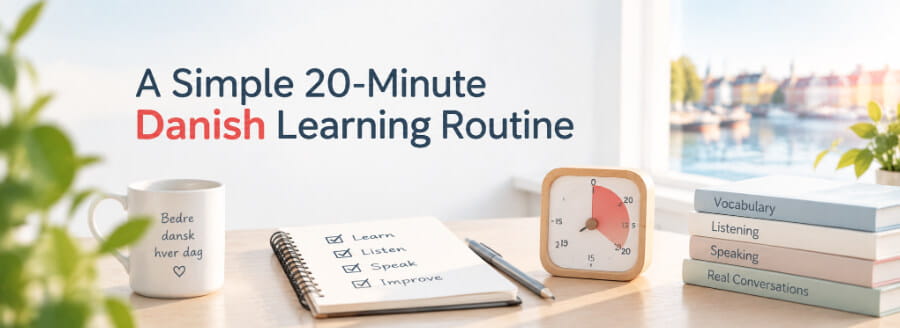
A Simple 20-Minute Danish Learning Routine
You don’t need to study Danish for two hours every day.
Try something like this:
5 minutes — Vocabulary
Learn a few useful words or expressions.
5 minutes — Listening
Listen to a short piece of Danish.
5 minutes — Speaking
Repeat sentences or describe something around you.
5 minutes — Conversation
Practice a short dialogue, speak with another learner, or work through a speaking exercise.
If you have more time, make each section longer.
If you only have ten minutes, make the session shorter.
The important thing is regular contact with Danish.
A short session you actually do is more useful than a perfect study plan you keep postponing.
A Beginner’s Roadmap to Learning Danish
If you’re starting from zero, don’t worry about reaching an advanced level immediately.
Think about your progress in stages.
Stage 1: Learn the basics
Learn greetings, introductions, numbers, everyday words and simple sentences.
Stage 2: Train your ears
Listen to Danish regularly and become familiar with its sounds and rhythm.
Stage 3: Start speaking
Use short sentences even when your vocabulary is limited.
Stage 4: Build everyday vocabulary
Learn words through situations, conversations and topics that matter to you.
Stage 5: Have real conversations
Start speaking with other people and learn how to deal with moments when you don’t understand something.
Stage 6: Increase your exposure
As your Danish improves, spend more time with Danish videos, audio, reading and conversations.
You don’t have to completely finish one stage before moving to the next.
They can overlap.
In fact, they should.
What If You Don’t Understand Spoken Danish?
This is one of the most common frustrations for beginners.
You may understand a sentence when you read it but struggle when someone says it naturally.
Don’t take that as a sign that you aren’t learning.
Your brain is simply dealing with a different version of the language.
Try listening to short pieces repeatedly.
The first time, focus on the overall sound.
The second time, listen for words you recognize.
The third time, see if you can catch the main idea.
You don’t need to understand everything.
You just need to understand a little more than you did before.
And when you’re having a conversation, it’s completely fine to ask someone to repeat themselves or explain something differently.
Communication doesn’t stop because you missed one sentence.
Don’t Be Afraid of Making Mistakes in Danish
You will probably pronounce something incorrectly.
You may put a sentence together in a way that sounds strange.
That’s part of learning.
Instead of treating every mistake as a failure, use it as information.
If you keep forgetting the same word, you know what you need to practice.
If a particular sound is difficult, you know where to focus.
If you understand written Danish but struggle with conversations, you probably need more listening and speaking practice.
You don’t have to wait until your Danish is perfect before using it.
Using the language is part of learning the language.
Make Danish Part of Your Everyday Life
You don’t need to turn Danish into a second full-time job.
Find small ways to bring it into your normal day.
Listen to Danish while you’re walking.
Read a short Danish text.
Write a few sentences.
Repeat useful expressions aloud.
Watch something in Danish.
Talk to another learner.
Notice a Danish word when you see it online.
Use the phrases you’ve learned whenever an opportunity appears.
These small moments add up.
And over time, Danish becomes less like something you’re studying and more like something you’re actually familiar with.
Start Small and Keep Using Danish
Learning Danish online doesn’t have to begin with a huge commitment.
Start with a few useful phrases.
Get comfortable with æ, ø and å.
Listen to Danish regularly.
Work on pronunciation.
Use a free resource if that’s enough for your needs.
Choose a structured course if you prefer more guidance.
And, whenever possible, have real conversations.
You don’t need to know thousands of words before Danish becomes useful.
You just need to start using the words you already know — and keep adding to them.
A language becomes much more meaningful when it moves from your screen, notebook or lesson and into a real conversation.