I Didn’t Know How to Say It in Spanish — So I Asked
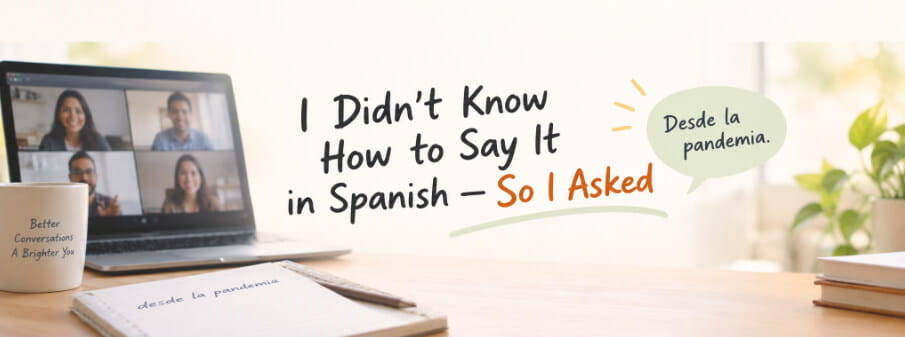
I started learning Spanish during the pandemic.
Then things went back to normal, life got busy, and somewhere along the way, I stopped practicing.
Not for a few weeks or a few months.
Almost four years.
Last month, I started again.
I also restarted our Spanish practice sessions, with the help of fluent speakers and native Spanish-speaking friends. And during one of those sessions, something very small happened that reminded me why I enjoy learning languages through real conversations.
The Moment I Got Stuck
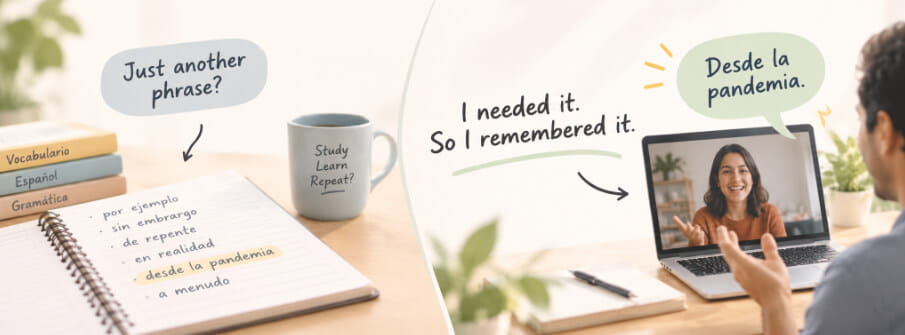
I was in a Zoom breakout room, telling people about my Spanish journey.
I was explaining that I had started learning Spanish during the pandemic, stopped practicing when life got busy, and had recently started again.
Then I reached a small gap.
I knew exactly what I wanted to say.
I just didn’t know how to say “since the pandemic” naturally in Spanish.
So I asked:
“How do you say ‘since the pandemic’?”
Someone answered:
“Desde la pandemia.”
I thanked them and continued telling my story.
That’s it.
The conversation didn’t stop. Nobody gave me a long grammar explanation. I didn’t open a notebook or add the phrase to a flashcard.
I simply needed the phrase, someone helped me, and I used it.
But I knew I would remember it.
I Wasn’t Trying to Learn a New Phrase
That’s what made the moment different for me.
I wasn’t sitting down to study Spanish vocabulary.
I wasn’t thinking, Today I need to learn some new expressions.
I was simply trying to tell someone something about my own life.
And suddenly, I needed a phrase I didn’t know.
There was a real reason for learning it.
I had a question, someone gave me the answer, and I immediately had a chance to use it.
Now desde la pandemia isn’t just a Spanish phrase whose meaning I know.
It has a story attached to it.
I remember the conversation.
I remember what I was trying to say.
I remember asking someone.
And I remember using it a few seconds later.
The phrase suddenly had a place to live.
Sometimes a Word Comes With a Story
We learn vocabulary in many different ways.
Sometimes we see a word in a book. Sometimes we learn it from an app, a video, a teacher or a list of useful expressions.
Those methods have their place.
But there is something different about discovering a word because you actually need it.
You’re talking about your work, your family, your weekend, your travels — or, in my case, your four-year break from Spanish.
Then you suddenly realize:
I don’t know how to say this.
So you ask.
Someone helps.
And you keep talking.
The new language is no longer just something you studied. It has become part of something that actually happened to you.
I can’t say that every word learned this way will automatically stay in your memory.
But I can say that this one feels different to me.
I didn’t just learn it.
I experienced it.
The Conversation Just Continued
I also liked how normal the whole thing felt.
Not knowing something didn’t turn into a big problem.
I didn’t have to leave the conversation and look for the answer myself. I didn’t have to pretend I knew the phrase.
I just asked.
And then we continued.
That might sound like a very small thing, but after almost four years without regular Spanish practice, it felt important.
For a long time, Spanish had mostly been something I used to learn.
Now I was actually using it again.
And in that moment, the gap in my Spanish wasn’t something I needed to hide. It was simply part of the conversation.
Sometimes you discover the exact language you need while you’re trying to say something.
You don’t always know beforehand which words are going to matter to you.
The Phrase I Needed Wasn’t in My Plan
That’s probably the part I find most interesting.
If someone had given me a list of Spanish phrases to learn that day, I don’t know whether desde la pandemia would have stood out to me.
Maybe I would have read it, understood it and forgotten it.
Instead, I needed it.
It was connected to something personal.
And because I used it immediately, I knew exactly where it belonged.
That’s something I’ve started thinking about differently since restarting Spanish.
Maybe I don’t need to remember every new word I come across.
Maybe I should pay more attention to the words I actually need to communicate something I want to say.
Those moments are easy to miss.
But they can be valuable.
What I Want to Do Differently This Time
Since restarting Spanish, I want to notice these little gaps more.
If I don’t know how to say something I genuinely want to say, I don’t necessarily want to see that as a failure.
Maybe it’s simply a piece of language I haven’t learned yet.
And if someone helps me with it, I’ll try to notice it.
I don’t need to collect every new word.
I just want to remember the ones that become useful in my own conversations.
The ones that answer a question I actually had.
The ones I use immediately.
The ones that somehow become connected to a person, a place or a moment.
Those are the words that feel different.
Four Years Later, I’m Starting Again
It’s funny.
After almost four years away from regular Spanish practice, one of the things that made the language feel alive again wasn’t a new app, a new textbook or a complicated study plan.
It was a few seconds in a Zoom conversation.
I didn’t know how to say something.
I asked.
Someone helped me.
I used it.
And the conversation continued.
I still remember desde la pandemia.
Not because it’s a difficult phrase.
I remember it because I needed it.
And maybe that’s one of the things I had forgotten during those four years.
Language isn’t only something you study.
Sometimes it’s something you discover while you’re trying to communicate with another person.
Sometimes another person gives you the word you were looking for.
And sometimes, a conversation doesn’t just help you practice a language.
It gives the language a memory.