
How to Learn French Vocabulary and Remember What You Learn

Learning French vocabulary is about more than memorizing the English meaning of a word. You also need to recognize it when you hear it, remember it when you want to speak, and know how to use it in a sentence.
You might learn ten new words today and forget some of them tomorrow. You might also understand a French sentence when reading it but struggle to say something similar yourself.
This is a normal part of learning a language.
The trick is to make vocabulary practice useful from the beginning. Learn words you are likely to need, notice how they are used in French, and give yourself opportunities to remember and use them.
Here are some practical ways to build your French vocabulary and make it part of your everyday language.
1. Start With French Words You Actually Need
When you start learning French, it can be tempting to collect as many new words as possible. But learning more words is not always the same as making useful progress.
Think about the situations in which you want to use French.
If your goal is everyday conversation, start with greetings, common questions, family, food, work, hobbies, and daily activities. If you are learning French for travel, you may want to focus on ordering food, finding places, booking accommodation, and asking for help.
For example, these expressions are useful in many situations:
- Bonjour — Hello
- Merci — Thank you
- Je ne comprends pas. — I don’t understand.
- Où est… ? — Where is…?
- Je voudrais… — I would like…
- Pouvez-vous m’aider ? — Can you help me?
You don’t need to learn all of them at once. Choose a few that match your current needs and practice using them.
As you become more comfortable with the basics, add words that help you talk about your own life, interests, and experiences.
The aim isn’t to know every French word. It’s to build a vocabulary that helps you understand others and express what you want to say.
2. Learn French Words Through Useful Examples
A word becomes more useful when you know how to use it in a sentence.
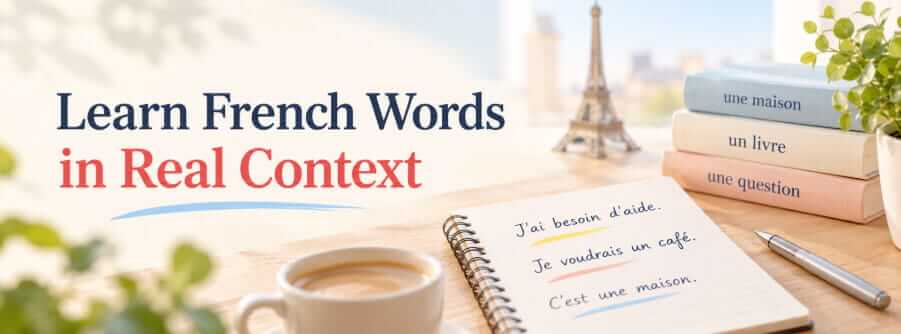
For example, besoin means “need”. Instead of learning only that translation, learn the expression:
J’ai besoin d’aide.
“I need help.”
You can then practice a few similar examples:
- J’ai besoin d’eau. — I need water.
- J’ai besoin de temps. — I need time.
- J’ai besoin de dormir. — I need to sleep.
The expression j’ai besoin de appears in each example, while the rest of the sentence changes.
This gives you a useful starting point when you want to express a similar idea. You can also replace the final word or phrase to make a sentence that suits your own situation.
When you come across a new French word, look at the sentence around it. Notice which words appear with it and how the expression is used.
Then try making one sentence of your own.
You don’t need to memorize a long list of examples for every new word. Start with one clear, useful sentence and build from there.
3. Learn French Nouns With Their Articles and Verbs in Expressions
French nouns have grammatical gender. Nouns are generally masculine or feminine, and this affects the articles and other words used with them.
That’s why it’s helpful to learn a noun together with its article rather than memorizing the noun alone.
For example:
- un livre — a book
- une maison — a house
- un restaurant — a restaurant
- une question — a question
- un problème — a problem
Instead of writing only maison in your vocabulary notebook, write une maison.
You can also learn it in a short sentence:
C’est une maison.
“It’s a house.”
This helps you remember the noun in a form you can use.
It’s useful to do something similar with common French verbs. Learn them in expressions that show how they work.
For example:
- avoir besoin de — to need
- avoir envie de — to feel like or want to do something
- avoir peur de — to be afraid of
You can practise them in sentences:
J’ai envie de sortir.
“I feel like going out.”
J’ai peur de parler français.
“I’m afraid of speaking French.”
These examples give you more than a single translation. They help you become familiar with expressions you can use when speaking or writing.
4. Learn Everyday French Expressions
Knowing individual words is useful, but conversations often depend on familiar expressions.
Think about the things you regularly say in your own language. You might explain your opinion, say that you’re unsure, ask someone to repeat something, or respond to a question.
Learning French expressions for these situations gives you language you can use in different conversations.
Here are a few examples:
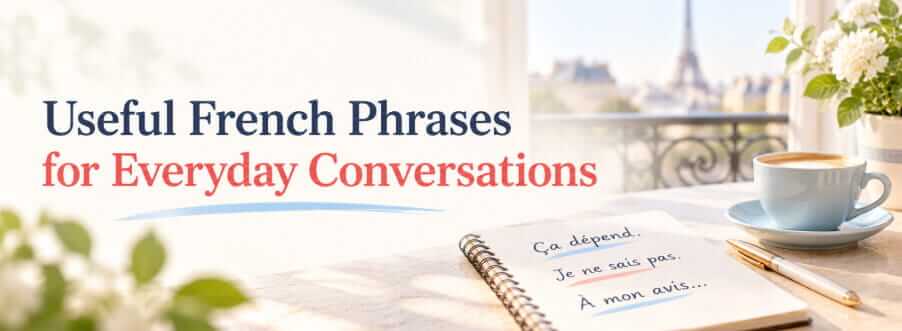
- Ça dépend. — It depends.
- Je ne sais pas. — I don’t know.
- À mon avis… — In my opinion…
- Je pense que… — I think that…
- Par exemple… — For example.
- Je voudrais… — I would like…
Try choosing one expression and using it in a few different sentences.
For example:
Je pense que c’est intéressant.
“I think it’s interesting.”
Je pense que c’est une bonne idée.
“I think it’s a good idea.”
You could then answer a simple question such as:
Qu’est-ce que tu aimes faire ?
“What do you like doing?”
Try answering with something you genuinely enjoy. You might need a few extra words to complete your answer, but that’s part of the practice.
Choose expressions that fit your level and the kinds of conversations you want to have. You can add more as your French improves.
5. Review French Vocabulary Regularly
Learning a word once doesn’t mean you’ll remember it forever. If you don’t revisit it, you may find it difficult to recall later.
Instead of trying to learn everything in one long session, return to useful words and expressions over time.
For example, you might review new vocabulary later the same day, the following day, a few days later, and again the next week. Adjust the timing according to how easily you remember each item.
When reviewing, try testing yourself rather than simply rereading your notes.
Cover the French word and see whether you can remember it from the English meaning. Then reverse the exercise: look at the French word and recall what it means.
You can also cover a complete sentence and try to say it again without looking.
If you forget something, check the answer and try again later. The point isn’t to get everything right every time. It’s to give yourself regular opportunities to remember what you’ve learned.
Flashcards, a notebook, or a simple vocabulary list can all help. Choose a method you’ll actually use.
For a more detailed explanation of review schedules and flashcards, see our guide to spaced repetition and SRS.
6. Find New French Words While Listening and Reading
French vocabulary doesn’t have to come only from a textbook or a word list. You can also discover useful words in conversations, short videos, stories, articles, and other material that interests you.
The trick is to notice a manageable number of new words rather than trying to learn every unfamiliar word you encounter.
Imagine you’re listening to a French conversation and hear je voudrais several times. You recognize that the expression is used to say what someone would like.
Write it down, check its meaning if necessary, and notice the sentence in which it appears.
You could then practise:
Je voudrais un café, s’il vous plaît.
“I would like a coffee, please.”
When reading, follow a similar approach. Choose a short text that is reasonably comfortable for your level, identify a few useful words or expressions, and look at how they’re used in the surrounding sentences.
You don’t need to stop every time you encounter an unfamiliar word. Focus on vocabulary that seems useful, appears repeatedly, or relates to something you want to talk about.
Over time, you’ll build a collection of words and expressions that come from the French you’re actually reading and hearing.
If understanding spoken French is a challenge, our guide to listening comprehension practice offers more help with that skill.
7. Make French Vocabulary Part of Your Daily Life
The words you learn become more relevant when they connect to your own interests and experiences.
If you enjoy cooking, learn French words for ingredients, meals, and kitchen activities. If you enjoy music, learn vocabulary related to songs, instruments, and the kinds of music you like. If you want to talk about your work, focus on words and expressions that help you describe your daily tasks.
You can then use that vocabulary to say something about yourself.
For example:
J’aime écouter de la musique.
“I like listening to music.”
Je cuisine souvent à la maison.
“I often cook at home.”
Je travaille dans un bureau.
“I work in an office.”
These sentences are simple, but they give you a starting point for talking about familiar subjects.
You can make them more detailed as you learn more vocabulary. You might explain what kind of music you like, what you enjoy cooking, or what you do at work.
You can also describe your day in a few French sentences or write a short paragraph about something that happened recently.
The benefit is that you’re not learning words only because they appear on a list. You’re learning language that helps you express things you actually want to say.
Try This: A Short French Vocabulary Exercise
Let’s put these ideas into practice.
Try translating the following sentences into French before checking the answers.
- I need water.
- I would like a coffee, please.
- It’s a house.
- I feel like going out.
Answers
- J’ai besoin d’eau.
- Je voudrais un café, s’il vous plaît.
- C’est une maison.
- J’ai envie de sortir.
After checking your answers, cover the French sentences and try saying them again.
Then change one part of a sentence to make it more personal. For example, replace un café with something else you’d like to order, or change sortir to another activity you want to do.
This small exercise gives you practice recalling words, recognizing familiar expressions, and using them in sentences.
A Simple Daily French Vocabulary Routine
You don’t need to spend hours learning new words every day. A short session that combines review, new vocabulary, and practice can be easier to maintain.
Here’s one routine you can try in about 15 minutes.
Minutes 1–4: Review what you’ve already learned
Look at a few familiar words or expressions. Test yourself before checking the answers.
Minutes 5–8: Learn a few new items
Choose around three to five useful words or expressions. Learn their meanings and look at a simple French example for each.
Minutes 9–12: Make your own sentences
Use the new vocabulary to write or say a few sentences about your life, interests, or daily activities.
Minutes 13–15: Practice aloud
Say the sentences aloud. Check the pronunciation of unfamiliar words and repeat the sentences until they feel more familiar.
Treat this as a flexible routine rather than a strict target. On some days, you may want to review old vocabulary instead of adding new words. On other days, you may find a useful expression while watching a video or reading a short text.
You can adjust the time to suit your schedule. What matters is having a manageable way to return to your vocabulary and use it.
Start Using the French You Learn
Building your French vocabulary takes time. You’ll forget some words, remember others more easily, and discover that certain expressions are much more useful to you than others.
That’s all part of learning.
Instead of measuring progress only by how many words you’ve memorized, pay attention to what you can understand and express.
Can you describe your day? Ask a simple question? Explain what you like? Respond to someone using a phrase you’ve recently learned?
These are useful signs that your vocabulary is becoming part of your French.
Keep learning words that matter to you, review them regularly, and give yourself opportunities to use them. You don’t have to wait until you know thousands of words before you start communicating.
The more you practice moving from learning a word to using it, the more useful your French vocabulary becomes.


