What to Say When You Don’t Know a Word in Another Language

You know what you want to say.
You just don’t know the word.
You’re in the middle of a conversation, the sentence is going well, and suddenly your brain decides to hide one very important word.
You pause.
You search your memory.
Nothing.
You try translating it from your native language.
Still nothing.
Now the other person is waiting.
This is one of the most frustrating moments when speaking another language. But it doesn’t have to end the conversation.
You don’t need to know every word to communicate well. You need to know what to do when a word is missing.
One of the most useful skills you can develop is learning how to explain an idea using the words you already know.
You Don’t Need the Perfect Word to Keep Talking
Imagine you’re speaking English and you suddenly forget the word umbrella.
You could stop and think:
“Umbrella… what’s the word?”
Or you could say:
“It’s the thing you use when it’s raining.”
The other person will probably understand immediately.
They might even help:
“You mean an umbrella?”
And you can simply say:
“Yes! Umbrella.”
The conversation continues.
That’s the important part.
You didn’t know the word at that moment, but you still communicated your meaning.
Real conversations aren’t vocabulary tests. People forget words, explain things differently, ask for help and correct themselves all the time.
The goal isn’t to speak without ever getting stuck.
The goal is to know how to keep going when you do.
What Is Circumlocution in Language Learning?
There is a name for this strategy: circumlocution.
In language learning, circumlocution means describing or explaining a word or idea using other words when you don’t know or can’t remember the exact term.
For example, instead of saying:
“I forgot the word umbrella.”
you might say:
“It’s something you use to protect yourself from the rain.”
You are communicating the idea without using the word itself.
In everyday language, circumlocution can sometimes mean talking in a roundabout or unnecessarily complicated way. But in language learning, it can be a useful communication strategy.
It helps you deal with vocabulary gaps without abandoning the conversation.
And that’s exactly why it’s worth practicing.
7 Ways to Explain a Word You Don’t Know
You don’t have to give a perfect dictionary definition.
You just need to give the other person enough information to understand what you mean.
Here are some simple ways to do it.
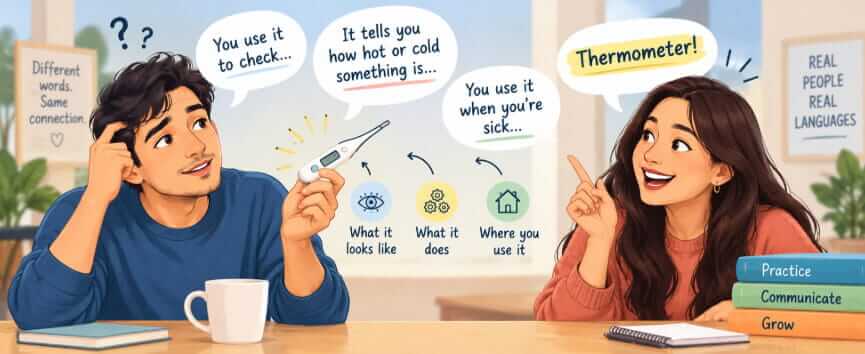
1. Describe What It Looks Like
Start with its appearance.
For example, you forget the word scissors.
You could say:
“It’s a tool with two sharp parts. You hold it with your fingers and use it to cut things.”
You don’t need to remember the word scissors.
The description does the job.
You can describe:
- its size
- shape
- color
- parts
- material
- appearance
Even a very simple description can give the other person enough clues.
2. Explain What It Does
Sometimes describing how something looks is difficult.
Instead, explain its purpose.
Forgot charger?
“It’s what you use to charge your phone.”
Forgot thermometer?
“It’s something you use to check your temperature.”
Forgot remote control?
“It’s the thing you use to change the TV.”
Think:
What do people use it for?
That question can often help you find a way around a missing word.
3. Give an Example
You can also explain a word by giving examples.
Suppose you forget the word fruit.
You could say:
“Apple, banana and orange. What do you call that group?”
Or you forget furniture:
“Things like tables, chairs and sofas.”
You don’t always need to define something.
Sometimes examples are enough.
This works particularly well when you’re talking about categories, foods, activities, objects or groups of things.
4. Use a Simpler Word
This is one of the easiest strategies, and learners often forget about it.
You don’t always need an exact replacement.
If you forget:
vehicle
you can say:
“car”
If you forget:
beverage
you can say:
“drink”
If you forget:
residence
you can say:
“home”
The simpler word may not have exactly the same meaning, but if it communicates what you need, that’s often enough.
During a conversation, being understood is usually more important than choosing the most precise word possible.
You can always learn the more specific word later.
5. Compare It With Something You Know
Another useful phrase is:
“It’s like…”
For example:
“It’s like a small motorcycle, but smaller and lighter.”
Or:
“It’s like speaking, but very quietly.”
Or:
“It’s like a small house, usually in the countryside.”
You are giving the listener something familiar to connect with the unfamiliar idea.
Comparison can be especially useful when you know what something is similar to, but can’t remember its exact name.
6. Say Where You Find It
Location can give the other person another clue.
Forgot pillow?
“It’s on your bed. You put your head on it when you sleep.”
Forgot elevator?
“It’s in a building. You use it to go up and down between floors.”
Forgot fridge?
“It’s in the kitchen. You put food inside to keep it cold.”
You don’t need to describe everything.
Just give the listener a useful clue.
7. Ask the Other Person
And sometimes the easiest solution is simply to ask.
You can say:
- “What’s the word for that?”
- “What do you call this?”
- “How do you say this in English?”
- “I can’t remember the word.”
- “I know what it means, but I can’t remember the word.”
- “It’s on the tip of my tongue.”
These are normal conversation phrases.
Asking for help doesn’t mean you’ve failed.
You’re having a conversation, and conversations involve two people.
When Words Aren’t Enough, Use a Gesture
Communication isn’t only about words.
If you forget scissors, you can make a small cutting gesture.
If you forget umbrella, you can imitate opening one.
If you forget drinking, you can pretend to hold a glass.
A gesture combined with a few words can sometimes communicate an idea faster than a long explanation.
You don’t need to become an actor every time you forget a word.
Just remember that you have more than one way to communicate.
Words are one tool. They’re not the only tool.
Don’t Translate the Whole Sentence
One of the easiest ways to get stuck is to make the missing word a bigger problem than it needs to be.
Imagine you know exactly what you want to say in your native language.
You don’t know one word in the language you’re speaking.
So you start thinking:
“What’s the English word for this?”
Then you try to translate it.
Then you translate another part of the sentence.
Then you lose the original sentence completely.
Instead, take a step back.
Ask yourself:
“How can I explain this using the words I already know?”
That’s a much easier question.
You’re no longer trying to find one perfect word.
You’re trying to communicate an idea.
This is one reason learning how to work around vocabulary gaps can also make you a more flexible speaker.

Don’t Let One Missing Word Make You Freeze
For some learners, forgetting one word immediately creates panic.
They think:
“I don’t know this word. My language is terrible.”
But the other person may simply be thinking:
“They forgot a word.”
That’s it.
Native speakers forget words too.
They say things like:
“What’s that word again?”
“You know, the thing…”
“I can’t remember the name.”
Forgetting a word is not proof that you don’t know the language.
It’s just a normal part of using it.
And the more comfortable you become with these moments, the less likely you are to freeze when they happen.
If you often find yourself freezing when someone speaks to you, you may also find it useful to look at why you freeze when speaking another language.
Let the Other Person Help You
There is another reason this strategy works so well in real conversations.
The other person can often give you the missing word.
Imagine this:
You: “It’s the thing you use when it rains.”
Other person: “An umbrella?”
You: “Yes! Umbrella.”
That’s not a failed conversation.
That’s a conversation.
You communicated an idea, the other person understood you, and you learned or retrieved a useful word.
This is one of the reasons real conversations are so valuable for language learning.
You don’t have to wait until your vocabulary is perfect before talking to people.
Talking to people gives you opportunities to discover the words you actually need.
Practice Describing Things Without Naming Them
You can practice this skill even when you’re alone.
Choose an everyday object and describe it without saying its name.
For example:
Object: coffee mug
“It’s a type of cup. It’s usually bigger than a normal cup, and people often drink coffee or tea from it.”
Now try:
- bicycle
- backpack
- toothbrush
- balcony
- refrigerator
- passport
- traffic light
Once that feels easy, make it harder.
Try describing abstract ideas such as:
- confidence
- patience
- embarrassment
- freedom
- success
These are more difficult because you can’t simply describe their shape or location.
You have to explain the idea.
That makes the exercise much closer to what happens in a real conversation.
Try the Three-Clue Exercise
Here’s another simple exercise.
Choose a word and give yourself three clues without saying it.
Example
Word: airport
Clue 1: It’s a place.
Clue 2: You go there when you’re travelling.
Clue 3: You get on a plane there.
Now try another.
Word: umbrella
Clue 1: You usually carry it.
Clue 2: You use it when it rains.
Clue 3: It opens above your head.
You can do this exercise with objects around your home.
You can also ask a language partner to guess the word.
That makes the exercise more interactive — and much more like a real conversation.
Keep a List of Words You Couldn’t Remember
There is one more thing worth doing after the conversation.
If you couldn’t remember an important word, write it down afterward.
For example:
“Today I couldn’t remember umbrella.”
Then create a sentence:
“I always carry an umbrella when it looks like rain.”
This is more useful than simply adding a random word to a vocabulary list.
The word is now connected to a real communication problem you experienced.
You can even keep a small list called:
Words I Couldn’t Remember
After a few weeks, look at the list.
You may notice that certain words keep coming up.
Those are probably worth learning.
Don’t Stop the Conversation to Find Every Word
It’s tempting to stop everything and search for the exact word.
Sometimes that’s useful.
But not every missing word deserves an immediate vocabulary investigation.
If the conversation is flowing and the meaning is clear, keep going.
You can learn the exact word later.
This is particularly important during speaking practice.
If you interrupt yourself every few seconds to find the perfect word, you may spend more time thinking about vocabulary than actually communicating.
Sometimes:
“The thing you use to…”
is better than five seconds of silence while you search your memory.
A Simple Formula to Remember
When you forget a word, you can use this simple sequence:
1. Stay calm.
Give yourself a second.
2. Use a simpler word.
Don’t search for a perfect replacement if a basic one works.
3. Describe it.
Say what it looks like or what it is.
4. Explain its purpose.
Tell the person what you use it for.
5. Give an example or comparison.
Use something familiar.
6. Ask for help.
Let the other person give you the word if necessary.
7. Keep talking.
Don’t let one missing word stop the whole conversation.
You won’t always need all seven steps.
Sometimes one sentence will be enough.
The Goal Isn’t to Know Every Word
Vocabulary is important.
But speaking a language isn’t simply a matter of collecting more and more words.
You also need to know what to do with the words you already have.
If you know 500 words but stop every time one is missing, conversation can still feel difficult.
If you know how to describe, compare, simplify, explain and ask for help, those 500 words can take you much further.
That’s one of the differences between studying a language and actually using it.
You learn to work with what you have.
And then, little by little, what you have gets bigger.
Make the Conversation Bigger Than the Missing Word
The next time a word disappears from your mind, don’t immediately assume the conversation has to stop.
You may remember the word a few seconds later. You may learn it from the person you’re talking to. Or you may finish the conversation without ever using it.
All three are okay.
The important thing is that the conversation continued.
And every time you successfully communicate without having the perfect word, you’re practicing an important part of real language use.
You don’t need every word before you can speak.
Sometimes, you just need another way to say it.
If you’d like more opportunities to practise with real people, explore Pep Talk Radio’s upcoming language events and find a conversation session for the language you’re learning.