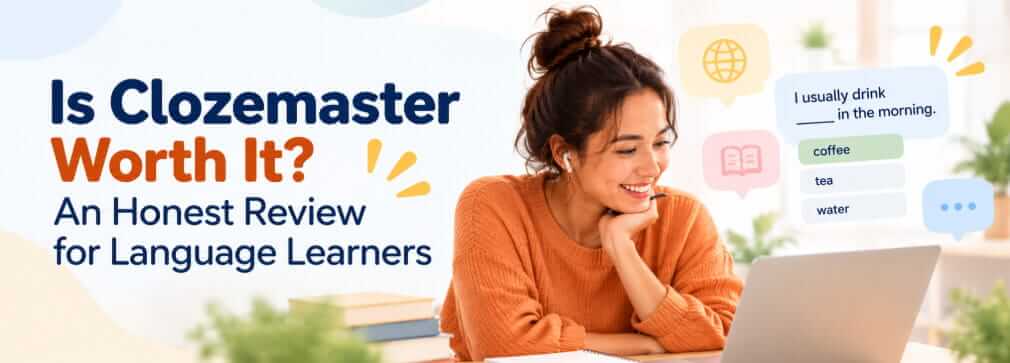
Is Clozemaster Worth It? An Honest Review for Language Learners
If you’ve already learned the basics of a language and want to build more vocabulary, you may have come across Clozemaster.
It looks a little different from a traditional language-learning app. Instead of taking you through a structured course, Clozemaster gives you sentences with a word missing and asks you to fill in the blank.
That simple idea is actually the main reason it can be useful.
You aren’t just looking at a list of words and trying to memorize translations. You’re seeing a word inside a sentence and trying to remember which word makes sense there.
But is Clozemaster worth using?
For many learners who already have some basic knowledge of their target language, it can be a very useful tool for practicing vocabulary in context and reviewing it regularly. At the same time, it isn’t a complete language course, and it shouldn’t be the only thing you use.
Here’s what Clozemaster does well, where it falls short, who it’s best suited to, and whether the free version or Clozemaster Pro is worth considering.
What Is Clozemaster?
Clozemaster is a language-learning platform built around cloze exercises.
A cloze exercise gives you a sentence with one word missing. Your job is to work out which word belongs in the blank.
For example:
I usually drink ___ in the morning.
You might choose coffee.
The point isn’t simply to learn the word coffee. You are seeing it in a sentence and using the surrounding words to work out what belongs there.
Clozemaster uses sentences and translations from the user-curated Tatoeba dataset, so the material comes from real sentence examples rather than a traditional lesson-by-lesson course. Clozemaster also notes that errors can occasionally appear in the dataset, which is something worth remembering when a sentence looks unusual.
This makes Clozemaster particularly interesting once you have moved beyond the very first stages of learning a language.

How Does Clozemaster Work?
The basic activity is straightforward.
You see a sentence with a missing word and then choose or enter the answer.
There are two main ways to answer:
- Multiple choice — choose the word that completes the sentence.
- Text input — type the answer yourself.
Text input requires more from your memory because the answer isn’t sitting in front of you.
Clozemaster also uses spaced repetition. A sentence that you answer correctly is brought back for review at increasing intervals. Its current default intervals are roughly 1 day, 10 days, 30 days and 180 days, with Pro users able to customize the review intervals.
There are also listening exercises where you hear a sentence before seeing it and then fill in the missing part. Clozemaster calls this cloze listening.
For Pro users, there is also cloze-reading, which lets you work with longer texts rather than only individual sentences.
So the basic experience is not complicated:
See a sentence → work out the missing word → answer → review it again later.
The value comes from doing that repeatedly with a large amount of language.
What Does Clozemaster Do Well?
1. It puts vocabulary into sentences
This is probably Clozemaster’s biggest strength.
Learning a word by itself can tell you what the word means. A sentence can show you how that word actually behaves.
You may notice:
- which words commonly appear around it
- how a verb is used
- what preposition follows it
- how a phrase is normally structured
- which form of a word belongs in the sentence
That makes the exercise more useful than simply seeing:
decidir = to decide
and moving on.
You have to deal with the word as part of a sentence.
2. It makes you retrieve the answer
There’s an important difference between recognizing a word and remembering it when you need it.
If you see:
I need to ___ my decision.
and immediately recognize change, that’s one kind of knowledge.
If you have to produce change yourself, you’re doing something different.
Clozemaster gives you plenty of opportunities to make that distinction.
3. Spaced repetition gives you a reason to come back
You don’t have to decide every day which vocabulary you should review.
Clozemaster’s review system brings sentences back according to its spaced-repetition schedule.
That can be useful because vocabulary tends to disappear when you only encounter it once.
Seeing the same language again after some time gives you another chance to retrieve it.
4. There is a lot of material
Clozemaster currently offers thousands of sentences across more than 50 languages, with different collections and difficulty levels.
That gives you plenty of room to keep going once you have finished the most basic material.
It also means you don’t have to stop after learning a few hundred common words. You can continue encountering vocabulary in different contexts.
5. Listening practice adds another dimension
Clozemaster isn’t limited to reading sentences.
Its cloze-listening mode lets you hear the sentence before seeing it and then work out the missing word from what you heard and the surrounding context.
That can make the same vocabulary feel different because recognizing a word on a screen is not quite the same as recognizing it when somebody says it.
What Clozemaster Doesn’t Do
Clozemaster can be useful, but it is easier to understand its value when you are clear about its limits.
It isn’t a complete beginner course
If you’re starting a language from zero, thousands of sentences with missing words may feel overwhelming.
You may not yet have enough vocabulary or grammar knowledge to understand why a particular answer fits.
For most complete beginners, a structured beginner course or textbook will probably provide a better starting point.
Clozemaster becomes more useful once you already understand some basic language and can use the surrounding sentence to work out what’s happening.
It doesn’t teach you everything you need to know about grammar
You will encounter grammar while using Clozemaster, and the sentences can help you notice patterns.
But noticing a grammar pattern isn’t the same as having it properly explained.
If you want to understand why a particular construction works, you may still need a grammar resource, teacher, textbook or another explanation.
It doesn’t automatically turn vocabulary into conversation
Knowing more words is helpful.
But knowing a word on an app doesn’t guarantee that you’ll remember it quickly when somebody asks you a question.
Real conversation involves listening, responding, choosing what to say, dealing with unexpected questions and adapting to another person.
Clozemaster can give you useful language to work with. You still have to use that language outside the app.
Some sentences may need checking
This is worth knowing before you treat every sentence as an unquestionable example of perfect language.
Clozemaster says its sentences and translations come from a user-curated Tatoeba dataset and acknowledges that errors can occur.
If a sentence seems strange, overly formal, outdated or simply doesn’t make sense to you, check it before memorizing it.
That’s a good habit with any large user-generated language resource.

Who Is Clozemaster Best For?
Clozemaster tends to make the most sense once you already have a foundation in your target language.
You don’t have to be advanced. In fact, it can be useful for learners who are somewhere between basic knowledge and more comfortable intermediate use.
It may be a good fit if:
- you already understand basic sentences
- you want to expand your vocabulary
- you like learning from examples
- you want regular review
- you enjoy short, repeatable practice sessions
- you want exposure to lots of sentences
- you are tired of studying isolated vocabulary lists
It may be less suitable if:
- you’re starting completely from zero
- you need step-by-step grammar lessons
- you want a course that takes you through a fixed curriculum
- you mainly want pronunciation or speaking lessons
- you expect one app to cover every part of language learning
Think of Clozemaster as a practice tool, rather than your entire language-learning system.
Is Clozemaster Free?
Yes. Clozemaster currently allows free users to play 30 sentences per day.
For many people, that’s enough to find out whether they actually enjoy the method.
You can use the free version for a while and see whether sentence-based practice fits naturally into your routine.
There is no particular reason to pay immediately just because Pro exists.
Is Clozemaster Pro Worth It?
That depends mostly on how much you use Clozemaster.
The free version is a good way to test the platform.
If you eventually find yourself wanting more practice, Pro removes the 30-sentence daily limit and adds features such as unlimited play, access to all available languages, sentence search, custom settings, advanced statistics, offline mobile use and cloze-reading. Pro also offers unlimited listening for supported collections in more than 30 languages.
So I’d look at Pro this way:
Use the free version first.
If you enjoy Clozemaster and regularly hit the daily limit, the additional features may make Pro worthwhile.
If you only use it occasionally, the free version may be all you need.
The important question isn’t really “Is Pro better?”
It obviously gives you more features.
The better question is:
“Am I using Clozemaster enough for those extra features to matter?”
How to Use Clozemaster Effectively
Clozemaster is simple enough that you can easily use it without thinking much about how you’re learning.
A few small habits can make the sessions more useful.
1. Start with a manageable amount
You don’t need to race through hundreds of sentences.
A smaller session that you actually remember can be more useful than a huge session that becomes a blur.
2. Look at the whole sentence
Don’t focus only on the missing word.
Read the sentence around it.
Ask yourself:
- What does the whole sentence mean?
- Why does this word fit here?
- Have I seen this expression before?
- Is there a useful phrase I could remember?
The surrounding words are part of the lesson.
3. Use text input when you can
Multiple choice is useful, especially when you’re getting started.
But if you already have a good idea of the answer, try typing it instead of simply choosing it.
That forces you to retrieve more of the word yourself.
4. Pay attention to useful expressions
Sometimes the most useful thing in a sentence isn’t the missing word.
You might see a phrase such as:
depende de
or
me di cuenta de que
or
por si acaso
Instead of remembering only one word, notice the expression as a whole.
That can give you language that is easier to recognize later in reading or conversation.
5. Check sentences that seem strange
If something doesn’t look right, don’t blindly memories it.
Look it up.
A quick check can prevent an unusual sentence from becoming something you later assume is normal everyday language.
6. Take useful language outside the app
This is the step that is easy to skip.
If you learn a useful expression today, try to notice it somewhere else.
Use it in writing.
Say it aloud.
Look for it when watching something in your target language.
Or try using it in a conversation.
The sentence on the screen is practice. What you do with it afterwards is where the language starts becoming more useful to you.
Where Does Clozemaster Fit Into Language Learning?
Clozemaster works best as one part of a larger routine.
A simple way to think about it is:
Learn the basics → build vocabulary → meet language in context → listen and read → speak → have real conversations
Clozemaster can sit comfortably in the middle of that process.
It can help you encounter and retrieve vocabulary in context.
It can give you repeated exposure.
It can give you listening practice in supported collections.
But other parts of your routine still matter.
You may need:
- a beginner course for the foundations
- grammar resources when something isn’t clear
- reading and listening for broader exposure
- speaking practice to actually use what you’ve learned
- real conversations to deal with unpredictable language
That last part matters.
You can know quite a lot about a language and still struggle when another person suddenly asks you something.
That’s a different skill from completing an exercise on a screen.
If that sounds familiar, you may also want to read our article on why knowing a language isn’t the same as being able to speak it.
Clozemaster vs. Traditional Flashcards
Traditional flashcards usually give you something like:
decidir
to decide
That’s useful for memorizing the basic meaning of a word.
Clozemaster changes the task:
No sabía qué ___.
Now you have to work out what belongs in the sentence.
The surrounding language gives you clues.
Neither approach is automatically better.
Flashcards can be excellent for learning and reviewing specific vocabulary. Clozemaster is particularly useful when you want to see vocabulary inside sentences and context.
For some learners, using both makes sense.
You can learn a word with flashcards and then encounter it repeatedly in real sentences.
Clozemaster Can Help You Know More. You Still Have to Use It.
This is probably the most important thing to keep in mind when using Clozemaster.
You might finish a session feeling that you recognized hundreds of sentences.
That’s good.
But language learning eventually has to move beyond recognition.
At some point, you need to take the words you’ve encountered and use them yourself.
Maybe you write a sentence.
Maybe you talk to yourself for a minute.
Maybe you message someone.
Maybe you join a language exchange or conversation group.
Maybe you have a real conversation and discover that the word you knew on the screen suddenly disappears when you need it.
That’s not a failure.
It’s useful information.
It tells you what needs more practice.
If you don’t have someone to practice with, you can also try practicing speaking a language without a conversation partner.
So, Is Clozemaster Worth It?
Yes — for the right learner.
If you’ve already built some basic knowledge of a language and want a practical way to expand your vocabulary through sentences, Clozemaster is worth trying.
Its biggest strength is also its simplest idea: you learn and review vocabulary inside sentences rather than only studying isolated words.
The free version is enough to test whether you like that approach. If you use it regularly and want more practice or the additional Pro features, upgrading can make sense.
But I wouldn’t treat Clozemaster as a complete language-learning solution.
Use it for what it does well.
Learn vocabulary in context.
Retrieve it.
Review it.
Listen to it.
Notice how the language is used.
Then take that language somewhere the app can’t go.
Into reading.
Into listening.
Into writing.
And eventually, into a real conversation with another person.
That’s when you find out what you actually remember.
And that’s also when language learning starts becoming language use.