
How Different Are Parisian and Canadian French?

If you are learning French, you might notice something interesting when you listen to people from France and Canada. You may understand one speaker quite easily, but find another harder to follow, even though both are speaking French.
Why does this happen?
French is spoken in many parts of the world, and it has developed different accents, expressions and vocabulary in different places. French spoken in Paris and French spoken in Quebec share the same foundation, but there are some differences worth knowing.
The good news is that you do not need to learn French all over again to understand another variety. Once you become familiar with common regional words and get used to different accents, conversations can become much easier to follow.
Let’s look at the main differences between Parisian French and Canadian French, with practical examples you can use in your own learning.
Parisian French vs. Canadian French: What’s the Difference?
First, a small clarification: Canadian French is not limited to Quebec. French is spoken in several Canadian communities, including Quebec and Acadian communities. The examples in this article focus mainly on French spoken in Paris and Quebec French, two varieties that many learners want to compare.
Both varieties share the same basic grammar and much of the same vocabulary. The main differences are in pronunciation, everyday words and regional expressions.
Here is a quick overview:
- Vocabulary: People may use different words for the same everyday things.
- Pronunciation: Some vowel and consonant sounds, along with rhythm and intonation, can differ.
- Expressions: Informal phrases that are common in one region may be unfamiliar in another.
- Everyday usage: Even familiar words can have different meanings or be used in different ways.
These differences are a normal part of language. Neither variety is better or more correct than the other.

1. Everyday Vocabulary: Different Words for the Same Thing
One of the easiest ways to notice regional differences is through everyday vocabulary.
You might learn a word in your French course and then hear another word for the same thing when speaking with someone from Quebec. This does not mean the word you learned was wrong. It simply means that people in different places sometimes use different terms.
Here are some useful examples.
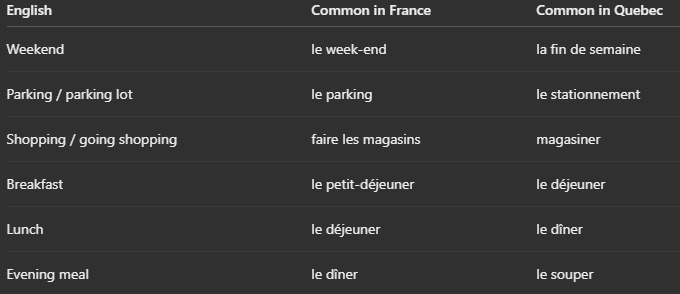
Useful expressions in Parisian and Canadian French
These are common regional preferences, not strict rules. You may hear different terms depending on the speaker, situation and region.
The meal names are especially useful to remember. In France, déjeuner usually means lunch, while in Quebec it commonly means breakfast. In Quebec, dîner usually means lunch and souper means the evening meal.
For example, imagine someone in Quebec asks:
« On se retrouve après le souper ? »
This means:
“Shall we meet after dinner?”
If you learned French mainly through speakers from France, you might need a moment to recognize souper. Once you know the word, however, the sentence becomes much easier to understand.
You may also hear char as an informal word for a car in Quebec, while voiture is widely used in both France and Quebec.
The important thing is to learn regional words when you encounter them, rather than assuming that every French speaker uses exactly the same vocabulary.
2. Pronunciation: Why French Can Sound Different
Pronunciation is another noticeable difference between French spoken in Paris and French spoken in Quebec.
Sometimes you may recognize every word when reading a sentence but struggle to understand the same sentence when someone says it. This is common among language learners, especially when they are used to hearing only one accent.
Quebec French has several characteristic pronunciation patterns. For example, in many Quebec varieties, the sounds /t/ and /d/ can be pronounced with an extra affricated quality before certain high front vowels. Some vowel sounds, sentence rhythms and intonation patterns can also differ from those commonly heard in France.
The exact pronunciation depends on the speaker, region and situation. Not everyone from Quebec speaks in the same way, just as not everyone in France has a Parisian accent.
What should you listen for?
When comparing speakers from France and Quebec, pay attention to three things:
- Vowels: Some vowel sounds may be noticeably different.
- Consonants: Certain sounds, including some pronunciations of t and d, may stand out.
- Rhythm and intonation: The way a speaker groups words and moves through a sentence can sound different.
You do not need to identify every sound or understand the technical details of phonetics. At first, simply noticing that the same words can sound different is useful progress.
Try listening to a short recording from each region. Listen once for the general meaning, then listen again and notice which words or sounds you recognize.
For more detailed help with French sounds, rhythm and speaking clearly, see our guide to French pronunciation practice.
3. Everyday Expressions and Informal French
Regional differences are not limited to individual words. People also use expressions that are more common in their own communities.
For example, magasiner is commonly used in Quebec to mean shopping or going shopping. In France, you are more likely to hear expressions such as faire les magasins.
Another informal expression you may hear in Quebec is:
C’est le fun !
Depending on the context, this can mean something like “It’s fun!” or “That’s great!”
You do not need to learn every regional expression at once. Some are informal, some are used more by particular age groups, and others may be more common in certain areas.
When you hear an unfamiliar expression, try to understand the whole sentence instead of translating each word separately.
For example, if someone uses an expression while talking about their weekend, notice what they are doing, how they feel and what the other person says in response. The context often helps you work out the meaning.
You can keep a small list of expressions you hear regularly, including the sentence in which each one appeared. This is more useful than collecting long lists of words you may never use.
4. Are the Grammar and Verb Tenses Different?
The basic grammar of French remains the same in France and Quebec. Both varieties use the same core verb system, and you do not need to learn a separate set of conjugations to communicate with Quebec French speakers.
There are differences in regional usage, informal speech and some expressions, but learners should be careful not to confuse these with entirely different grammar rules.
For example, both a speaker in Paris and a speaker in Quebec might say:
« J’ai fait mes devoirs. »
“I did my homework.”
The passé simple, as in je fis, is mainly associated with literary and formal written narration. It is not a defining feature of everyday Quebec French.
If you are still learning French grammar, focus on building a solid foundation first. As you listen to more speakers, you will gradually become familiar with regional expressions and informal ways of speaking.
You do not need to master every regional difference before you can have a useful conversation.
5. Can People in France Understand Quebec French?
Yes. Speakers of French from France and Quebec can generally understand one another, although some conversations are easier to follow than others.
The experience depends on several things:
- How familiar the listener is with the other variety.
- How quickly the person is speaking.
- Whether the conversation contains a lot of local expressions or slang.
- How clearly the speaker talks and how much context is available.
For example, a learner who has mainly listened to French from France might understand a Quebec speaker discussing everyday activities but struggle with a fast conversation full of unfamiliar expressions.
That does not mean the learner has learned the wrong French. It simply means they need more exposure to the variety they are hearing.
The same can happen in the other direction. Someone familiar with Quebec French may need time to adjust to unfamiliar vocabulary or expressions in France.
How can you get better at understanding different French accents?
Try this simple listening exercise:
- Choose a short recording. Find a short clip featuring a speaker from France or Quebec.
- Listen without subtitles. Focus on the main idea instead of trying to catch every word.
- Listen again with subtitles or a transcript. Notice the words you missed.
- Write down a few unfamiliar expressions. Focus on the ones that seem useful or appear more than once.
- Repeat with another speaker. Gradually expose yourself to different voices and accents.
You can practice these skills with our French listening comprehension resources.
Regular listening will help you become more comfortable with different speaking styles, even when you do not understand every word.
6. Which Variety of French Should You Learn?
If you are a beginner, you may be wondering whether to focus on Parisian French or Canadian French first.
The best choice depends on where you want to use French and the people you want to communicate with.
Focus on French spoken in France if…
- You plan to live, study or work in France.
- You regularly watch films or other media produced in France.
- Your course and learning materials mainly use French from France.
- You want to communicate with friends, colleagues or family members there.
Focus on Quebec French if…
- You plan to live, study or work in Quebec.
- You want to communicate more comfortably with people in Quebec.
- You regularly listen to Quebec media or follow local culture.
- You want to understand the vocabulary and expressions used in everyday life there.
What if you are not sure?
Start with the variety used in your main learning resources and build a strong foundation in French. As you progress, add listening practice from other French-speaking regions.
You do not have to choose one variety permanently. Learning French through speakers from France does not prevent you from understanding Quebec French, and the reverse is also true.
The most useful variety to begin with is usually the one that matches your immediate goals. You can broaden your understanding over time.
7. Try It Yourself: A Quick French Vocabulary Quiz
Let’s see how well you recognize some of the regional differences.
Question 1: Someone in France says they spent le week-end with friends. What does le week-end mean?
Question 2: Someone in Quebec says they are going to magasiner. What are they going to do?
Question 3: Someone in Quebec asks whether you want to meet after le souper. Which meal are they talking about?
Answers
- The weekend.
- Go shopping.
- The evening meal, or dinner.
If you knew all three, great! If not, you have learned a few useful expressions to listen for next time.
You can use the same approach with other topics, such as food, transport, work or weekend plans. Learning a few words at a time makes regional differences easier to remember.
8. How to Practice Both Varieties of French
You can become familiar with French from France and Quebec without turning your study routine into two separate courses.
Here is a simple way to practice.
Choose one topic. Start with something familiar, such as food, shopping, work or weekend plans.
Listen to speakers from both regions. Find short recordings about the same topic. Notice whether the speakers use different words or expressions.
Compare a few examples. Write down two or three differences you find interesting. You do not need to record everything.
Practice talking about the topic yourself. Describe your weekend, explain what you like to eat or talk about your daily routine.
For example, you might hear these two questions:
- France: « Qu’est-ce que tu fais ce week-end ? »
- Quebec: « Qu’est-ce que tu fais en fin de semaine ? »
Both ask what someone is doing over the weekend. The second uses a common Quebec expression, en fin de semaine.
Try answering the question in French, even if your answer is simple. You could say:
Je vais voir des amis.
“I’m going to see some friends.”
This is a useful way to connect what you hear with what you can actually say.
The aim is not to copy every detail of a particular accent. It is to understand more speakers, recognize regional differences and feel comfortable communicating in French.
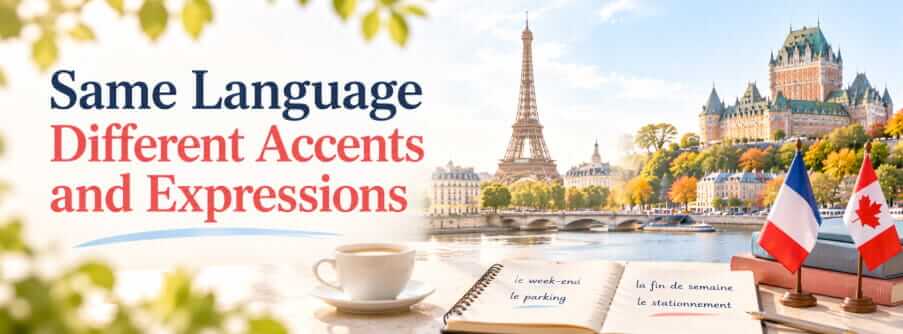
You Can Learn French Without Choosing Just One Variety
Parisian French and Quebec French share the same foundation, but they differ in pronunciation, everyday vocabulary and regional expressions.
You might hear le week-end in France and la fin de semaine in Quebec. You may also notice differences in meal names, informal expressions and the way certain sounds are pronounced.
These differences can take a little time to get used to, but they are a normal part of learning a language spoken by people in different places.
Start with the variety that best suits your goals. Listen regularly, notice the expressions people use and practice speaking whenever you have the chance.
You do not need to understand every accent or know every regional word before joining a conversation. The more French you hear and use, the more familiar these differences will become.
The goal is not just to learn French. It is to understand people and communicate with them.


