
8 Most Useful Languages to Learn in 2026
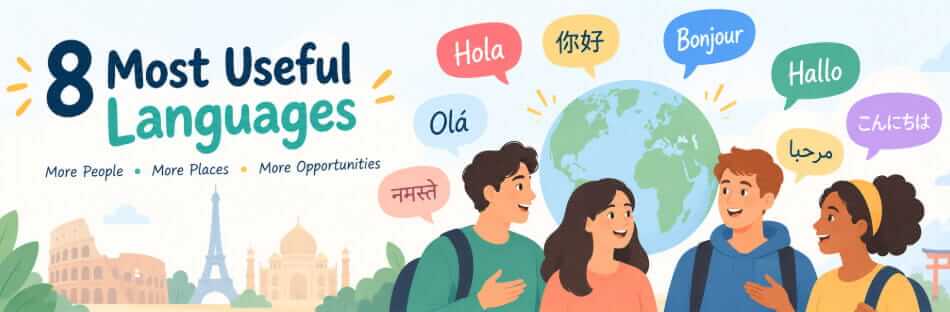
Choosing a language to learn is a big decision.
There are thousands of languages in the world, and each one can open the door to different people, places, cultures and experiences. But with so many choices, one question comes up again and again:
What are the most useful languages to learn?
The answer depends on what you mean by “useful.”
A language can be useful because millions of people speak it. It can be useful for travel, work, education or international communication. It can give you access to a large cultural community or help you communicate with people in several countries.
But there is another factor that is easy to overlook:
Will you actually use it?
The most useful language for you may not be the language with the largest number of speakers. It may be the language spoken by the people you want to meet, the country you want to visit, the community you want to join or the people you want to talk to regularly.
With that in mind, here are eight languages worth considering in 2026, along with why each one can be useful and who might benefit most from learning it.

What Makes a Language Useful?
There is no universal ranking that can tell everyone which language they should learn.
For this guide, usefulness means a combination of:
- Global reach — how many people and communities you can potentially communicate with
- Geographic reach — how widely the language is used across countries and regions
- Travel — how useful it can be when travelling
- Work and education — whether it can open professional or educational opportunities
- Culture — how much access it gives you to another cultural and media world
- Conversation — how many opportunities you may have to actually use the language
- Personal relevance — how closely the language connects to your own goals and interests
These factors don’t always point to the same language.
A language with hundreds of millions of speakers may be less useful to you than a language spoken by far fewer people if you have regular opportunities to use the second one.
That is why the list below should not be treated as a universal ranking.
The right language is the one that is useful for the life you want to live.
What About English?
If you don’t already speak English, it deserves special attention.
English has an enormous global reach because it is used both by native speakers and by a very large number of people as a second or additional language. It is also one of the six official languages of the United Nations, alongside Arabic, Chinese, French, Russian and Spanish.
English is particularly useful for:
- international communication
- travel
- education
- business
- technology
- online information
- international communities
- professional communication
For many people, English is the obvious first choice.
But if you already speak English, the more interesting question is:
Which language should you learn next?
That is where the eight languages below become especially useful.
1. Spanish
Spanish is one of the strongest choices for learners who want a combination of global reach, travel and real conversation.
It is spoken across Spain and much of Latin America, as well as by large communities elsewhere in the world. The Instituto Cervantes reported more than 635 million potential Spanish speakers worldwide in 2025, including more than 520 million people with native-level Spanish competence under its methodology.
That makes Spanish much more than a language associated with one country.
Learning Spanish can connect you with people across a large part of the Americas and with communities around the world.
Why learn Spanish?
Spanish can be useful for:
- travel
- friendships and relationships
- international communication
- work
- customer-facing professions
- Spanish-language media
- cultural experiences
- communicating across many countries
Another advantage is the number of opportunities to practise.
Spanish is widely taught around the world, so finding learning resources, conversation partners and communities is usually relatively easy.
And Spanish can become useful quite early in the learning process.
You don’t need to wait until you are fluent before having meaningful conversations. You can start with simple questions, everyday expressions and short exchanges, then gradually become more confident.
Best for: Travel, conversation, culture and connecting with people across many countries.
If you want a language that gives you many opportunities to actually speak with people, Spanish is one of the strongest choices.
2. Mandarin Chinese
Mandarin Chinese has one of the world’s largest native-speaking communities and is an important language for international communication, particularly in relation to China.
It is also one of the six official languages of the United Nations.
For many learners, Mandarin represents a long-term investment in language and cultural understanding.
Why learn Mandarin?
Mandarin can be useful for:
- business
- international communication
- travel
- professional relationships
- Chinese-speaking communities
- Chinese-language media
- cultural understanding
Mandarin can also challenge the assumption that a useful language has to be easy to learn.
For an English-speaking learner, the writing system and tones can require significant effort. But the difficulty of a language does not make it less useful.
If you have a strong reason to learn Mandarin and opportunities to use it, the effort can be worthwhile.
There is also an important advantage to learning Mandarin: it gives you direct access to a huge cultural and linguistic world that translation cannot fully reproduce.
Best for: International business, China-related work, culture, travel and people with a strong personal connection to Chinese-speaking communities.
3. French
French is one of the world’s major international languages and has an unusually broad geographic reach.
It is spoken in Europe, Africa, North America, the Caribbean and other parts of the world. The United Nations lists French among its six official languages, and French is also one of the two working languages of the UN Secretariat.
The geographic spread of French is one of its biggest advantages.
Learning French does not simply mean learning how to communicate in France.
It can give you access to conversations and communities across several continents.
Why learn French?
French can be useful for:
- international communication
- travel
- education
- diplomacy
- business
- international organisations
- culture
- communicating across several continents
French is particularly interesting for learners who want a language with both cultural depth and international reach.
It can also be a useful bridge into other Romance languages because of shared vocabulary and linguistic connections, although learning French does not automatically mean you can speak Spanish, Portuguese or Italian.
Best for: International communication, travel, culture, education and connecting with communities across several continents.
4. German
German is sometimes overlooked in general lists of the world’s most useful languages because it does not have the same number of speakers as Spanish, Mandarin or Hindi.
But usefulness is not only about speaker numbers.
German can be particularly valuable in Europe and in professional fields where Germany and other German-speaking countries have a strong presence.
Why learn German?
German can be useful for:
- working in Germany, Austria or Switzerland
- business
- engineering
- manufacturing
- science and research
- higher education
- travel
- communicating with German-speaking communities
Germany also has a strong role in European business and industry.
For someone planning to study, work or build professional relationships in German-speaking Europe, German may be far more useful than a language that appears higher on a global speaker-count list.
This is a good example of why your goals matter more than a universal ranking.
Best for: Europe, business, engineering, science, education and professional opportunities.
5. Arabic
Arabic is one of the world’s major languages and one of the six official languages of the United Nations.
But there is something important to understand before choosing Arabic.
“Arabic” is not simply one everyday spoken variety used identically across the entire Arab world.
Modern Standard Arabic is important in formal contexts, media and institutions, while everyday conversations often take place in regional varieties such as Egyptian Arabic, Levantine Arabic, Gulf Arabic or Moroccan Arabic.
The United Nations itself notes that spoken dialects are essential for everyday communication and that the appropriate variety depends on local communication needs.
Why learn Arabic?
Arabic can be useful for:
- travel
- business
- international affairs
- communication across the Arab world
- cultural understanding
- professional relationships
- connecting with Arabic-speaking communities
If you are considering Arabic mainly because you want to speak with people, think about where you want to use it before choosing what to study.
A learner who wants to live in Egypt may have different needs from someone moving to Morocco or working in the Gulf.
That decision can make your learning much more practical.
Best for: The Arab world, international affairs, travel, business and cultural connection.
6. Hindi
Hindi is one of the world’s largest languages by number of speakers and can be particularly useful for people who live in, travel through or work with communities in India.
India is one of the world’s most linguistically diverse countries, so Hindi should not be treated as a replacement for the many other major Indian languages.
But Hindi has an important role across large parts of the country and is spoken by a very large community.
Why learn Hindi?
Hindi can be useful for:
- everyday communication in many parts of India
- travel
- friendships and relationships
- Indian media
- business
- cultural understanding
- communicating with Hindi-speaking communities outside India
For someone living in India, the practical value of Hindi can also depend heavily on location.
In some places, another Indian language may be much more useful in everyday life.
That is a good reminder that language usefulness is always connected to people and place.
Best for: India, travel, relationships, culture and connecting with Hindi-speaking communities.
7. Portuguese
Portuguese is one of the most useful languages that people sometimes overlook.
Its biggest advantage is the combination of geographic reach and access to major communities, particularly in Brazil and Portugal.
Brazil alone makes Portuguese especially significant because of the country’s size, population and cultural influence.
Why learn Portuguese?
Portuguese can be useful for:
- travelling in Brazil and Portugal
- communicating with Portuguese-speaking communities
- business
- culture
- music and entertainment
- friendships and relationships
- exploring Portuguese-speaking countries and communities
Portuguese also has a close linguistic relationship with Spanish.
That can make some aspects of Portuguese more familiar to someone who already knows Spanish.
But the two languages are still different, and understanding Spanish does not mean you can automatically communicate naturally in Portuguese.
You still need to learn how Portuguese is actually spoken.
Best for: Brazil, Portugal, travel, culture and communication with Portuguese-speaking communities.
8. Japanese
Japanese is a useful reminder that speaker numbers are not the only measure of a language’s value.
Japanese has a much more concentrated geographic base than languages such as Spanish or French, but learning it can provide enormous personal and cultural value.
Japan has a distinctive cultural and media presence around the world, and Japanese is the key to experiencing that world directly rather than only through translation.
Why learn Japanese?
Japanese can be useful for:
- travelling in Japan
- living in Japan
- professional relationships
- business
- Japanese culture
- literature
- film and television
- music and entertainment
- personal connections
Japanese also makes sense for learners who have a specific reason to use it.
If you are planning to spend significant time in Japan, have Japanese friends or family, work with Japanese companies or simply have a deep interest in Japanese culture, your personal reason for learning may matter much more than the language’s position on a global speaker ranking.
Best for: Japan, travel, culture, professional relationships and people with a strong personal connection to the language.
Other Languages Worth Considering
No list of eight languages can cover every language that may be useful.
Several others deserve serious consideration depending on your goals.
Korean
Korean can be a strong choice if you have personal, professional or cultural connections to South Korea or want to engage directly with Korean-speaking communities and media.
Russian
Russian remains an important language across a large geographic area and is also one of the six official languages of the United Nations.
Italian
Italian may not compete with Mandarin or Spanish in global speaker numbers, but it can be highly useful for someone who regularly travels to Italy, has Italian family or friends, or wants direct access to Italian culture, food, art and history.
Other languages
There are also many regional and community languages that may be far more useful to you than any global ranking suggests.
If the people around you speak a particular language, learning that language can be one of the most meaningful choices you make.

The Most Spoken Language Isn’t Always the Most Useful
This is one of the easiest mistakes to make when choosing a language.
You see a list of the world’s most spoken languages and assume that the language at the top must be the best one to learn.
But speaker numbers answer only one question:
How many people speak it?
They do not answer:
How many of those people will I actually meet?
Imagine two learners.
One decides to learn Mandarin because it has an enormous number of speakers. But they have no Chinese-speaking friends, no plans to travel to China and no regular opportunity to practise.
Another person chooses Spanish because they travel regularly in Latin America, have Spanish-speaking friends and attend a Spanish conversation group every week.
For that second learner, Spanish may be much more useful.
The language with the larger number of speakers is not automatically the language with the larger number of useful conversations in your life.
Your Location Matters
Where you live can completely change the answer.
A language that is highly useful in one country may be much less useful somewhere else.
For example, someone living in India may have very different language priorities from someone living in Canada.
Someone working in Germany may benefit greatly from German.
Someone travelling repeatedly through Latin America may get enormous value from Spanish.
Someone working with clients in the Gulf may have a strong reason to learn Arabic.
Someone living in a multilingual city may have opportunities to use several different languages every week.
So before choosing a language, ask:
Who do I want to communicate with?
Where do I want to travel or live?
Which communities are around me?
What language do the people I want to meet speak?
These questions can be more useful than looking at a global ranking.
Your Reason for Learning Matters Too
There is another factor that statistics cannot measure very well:
motivation.
Suppose someone tells you that German is the most useful language for your career.
But you are fascinated by Japanese, have Japanese friends and spend your free time listening to Japanese music and watching Japanese films.
Which language are you more likely to practise for years?
Probably Japanese.
And that matters.
Language learning is not something you finish in a few weeks. Reaching a useful level requires repeated exposure, practice and real use.
A strong personal reason can help you keep going when learning becomes difficult.
Your motivation is therefore part of the usefulness equation.
The Language You Actually Use Is the One That Becomes Useful
Learning a language is different from collecting facts about a language.
You can memorize hundreds of words and still struggle to have a conversation.
You can study grammar for years and still freeze when someone asks you a simple question.
You can understand a lesson perfectly and then struggle to find the words you need in a real conversation.
That is why the usefulness of a language ultimately depends on what happens after you choose it.
Do you listen to it?
Do you speak it?
Do you use it with other people?
Do you have conversations?
Do you make mistakes and keep going?
Do you gradually learn how people actually express themselves?
That is when a language stops being just a subject you study and starts becoming something you can use.

How to Choose the Right Language for You
If you are still unsure, don’t try to find a perfect ranking.
Instead, answer these five questions:
1. Who do I want to talk to?
Think about real people rather than abstract numbers.
Friends, family, colleagues, customers, neighbours, travel partners or communities can all give you a strong reason to learn.
2. Where will I use the language?
Think about where you live, where you travel and where you may work or study.
3. What do I want to do with it?
Your goal could be:
- conversation
- travel
- work
- study
- relationships
- culture
- immigration
- personal interest
Different goals can lead to different choices.
4. Will I have regular opportunities to practise?
This question is often overlooked.
A language becomes much easier to maintain when you can use it regularly.
5. Am I interested enough to keep learning?
This may be the most important question of all.
If you are genuinely interested in the people, places or culture connected to a language, you are more likely to keep practising when progress feels slow.
So, What Is the Most Useful Language to Learn in 2026?
There isn’t one answer for everyone.
If you don’t already speak English, English remains one of the strongest choices for global communication.
Beyond English, Spanish, Mandarin Chinese, French, German, Arabic, Hindi, Portuguese and Japanese all offer different kinds of usefulness.
Spanish can give you enormous opportunities for conversation and travel.
Mandarin can connect you to one of the world’s largest language communities.
French offers remarkable geographic reach.
German can be highly valuable in European professional and educational settings.
Arabic can open communication across a diverse and important region.
Hindi can connect you with a huge community in India and beyond.
Portuguese gives you access to Brazil, Portugal and other Portuguese-speaking communities.
Japanese can provide deep cultural and personal value for people with a strong connection to Japan.
But there is a bigger lesson here.
You don’t need to learn the “perfect” language.
You need to learn a language that gives you a reason to keep learning it.
A language becomes useful when you use it to ask a question, understand someone, make a friend, solve a problem, travel somewhere new or simply have a conversation that would not have been possible otherwise.
So don’t only ask:
“Which language is the most useful?”
Ask:
“Which language will give me the people, places and conversations I want to be part of?”
That may be the better language for you.
And once you choose one, don’t wait until you feel fluent before you start using it.
Learn it. Practise it. Speak it. Connect with people.